

Cyst Removal
What are cysts and lipomas?
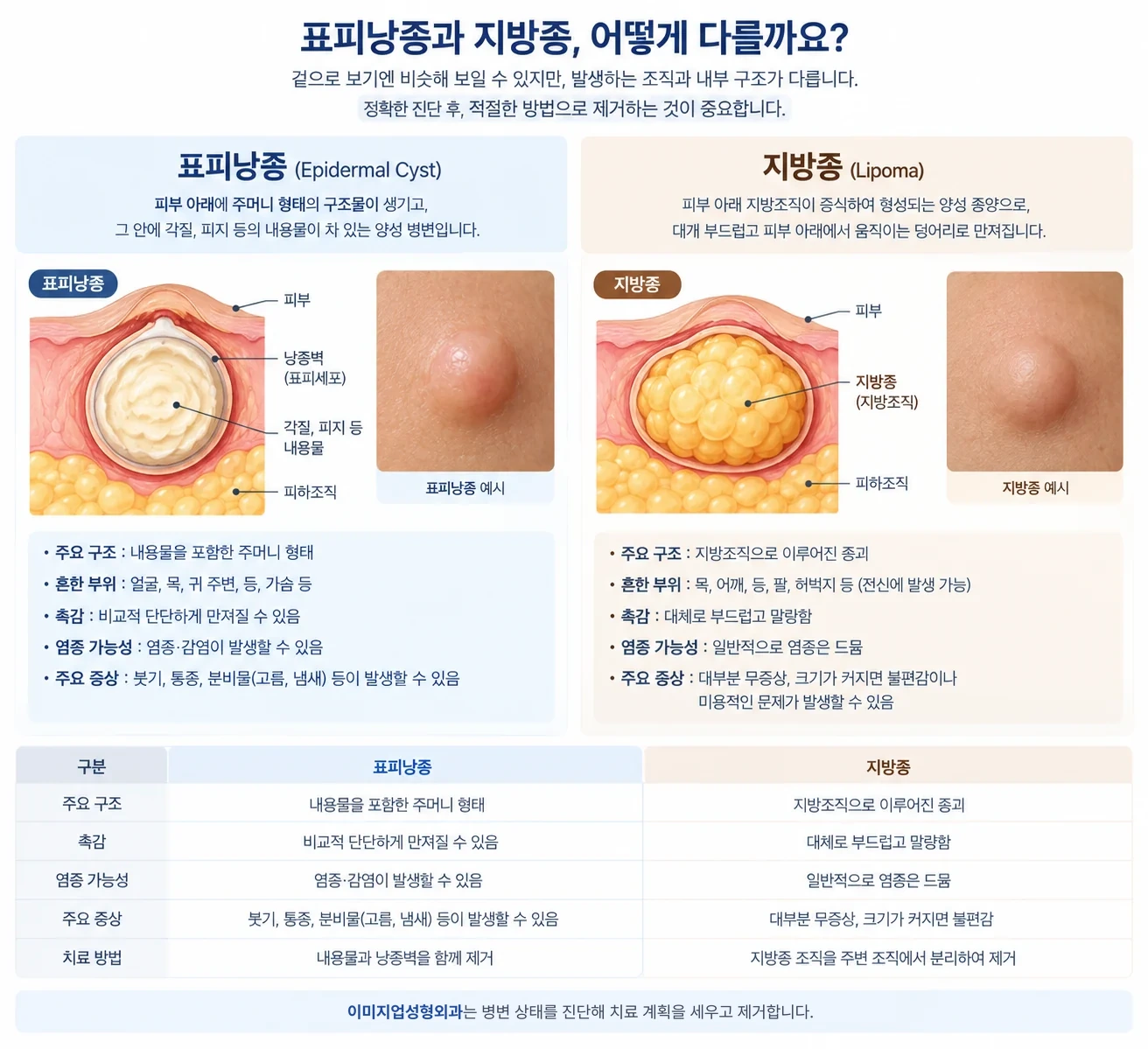
Lumps felt under the skin can arise from various causes, and representative benign tumors include epidermal cysts and lipomas. They may look similar from the outside, but because they arise from different tissues and have different internal structures, it is important to remove them with an appropriate method after an accurate diagnosis.
A cyst is a lesion in which a pouch-like structure forms under the skin and contents such as keratin accumulate inside it. It is often called a ‘sebaceous cyst,’ but in many cases it is actually an epidermal cyst. If inflammation develops, it may suddenly enlarge and become red, or cause pain, swelling, or discharge.
A lipoma is a benign tumor formed by the overgrowth of fat tissue under the skin and is usually felt as a soft lump that moves beneath the skin. Most are painless, but as they gradually grow, or depending on their location, they can cause discomfort or cosmetic concerns.
At ImageUp Plastic Surgery, we check the size, location, and depth of the lesion, its relationship with surrounding tissue, any inflammation, and the skin condition, and remove the lesion while planning the incision and suturing to reduce damage to normal tissue and post-operative scarring.
Epidermal cysts and lipomas: how are they different?
Cyst and lipoma removal surgery process
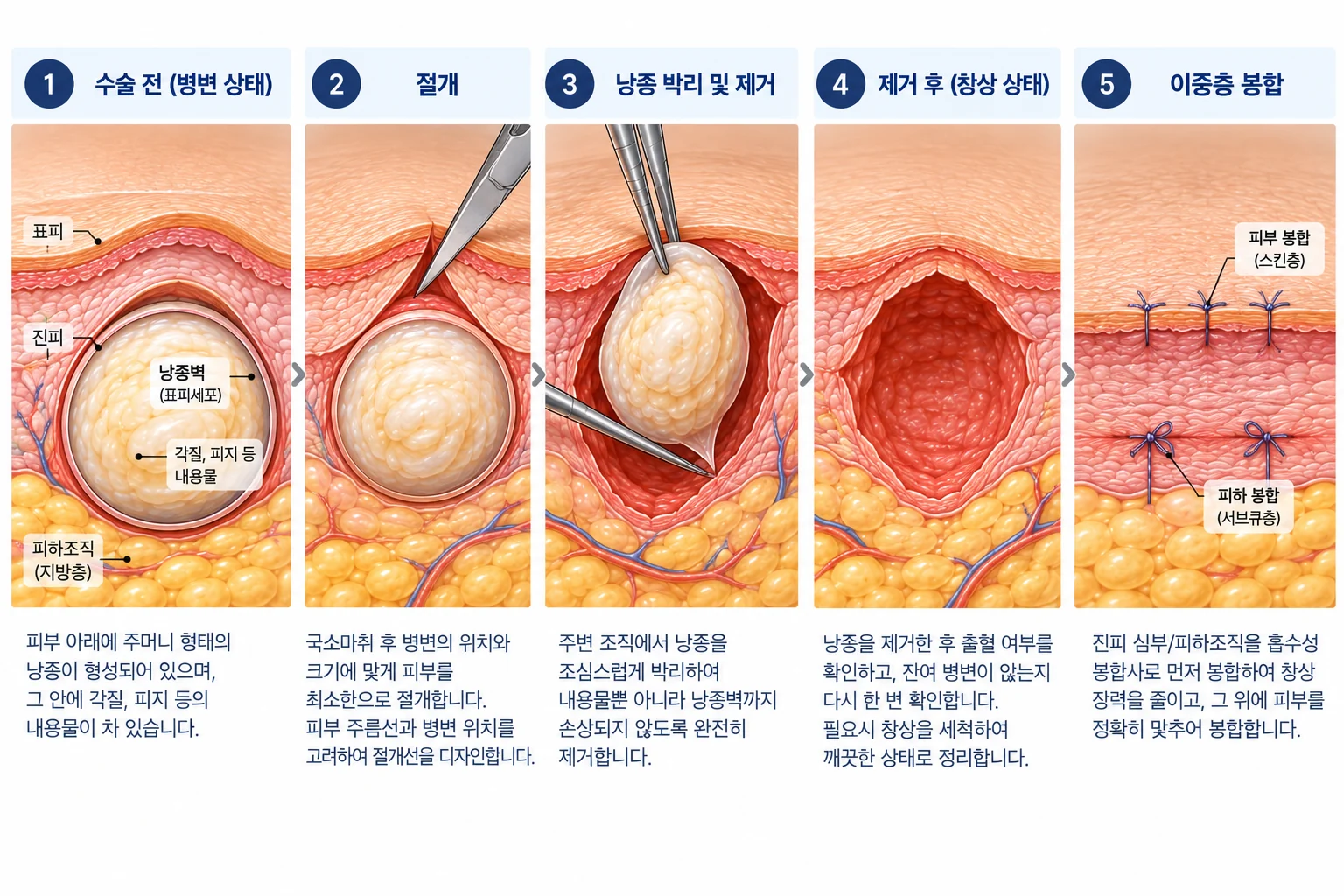
- 01
Diagnosis and surgical design
The size, location, and depth of the lesion, the skin condition, and its relationship with surrounding tissue are checked. If necessary, tests such as ultrasound are used to confirm the extent and characteristics of the lesion, and the incision line is designed in consideration of skin creases and the lesion location.
- 02
Incision to the extent necessary
After local anesthesia, the skin is incised according to the size and location of the lesion. The lesion is approached while minimizing damage to normal skin and surrounding tissue.
- 03
Lesion dissection and removal
For cysts, not only the contents but also the cyst wall is removed; for lipomas, the lipoma tissue is separated from the surrounding normal tissue, dissected, and then removed. It is important to remove the lesion as completely as possible according to its characteristics.
- 04
Hemostasis and precise suturing
After the lesion is removed, bleeding and any remaining lesion are checked, and the skin layers are aligned and sutured. Depending on the location and size of the lesion, the incision line and suturing are finished carefully with post-operative scarring in mind.
- 05
Recovery and biopsy
The surgical site is disinfected and dressed, and the healing of the wound is checked. If necessary, the removed tissue undergoes a histopathological examination to confirm an accurate diagnosis.
Key points of cyst and lipoma removal surgery
Removal surgery may be considered in these cases
- When a lump under the skin gradually grows
- When it repeatedly swells or becomes inflamed
- When there is pain, a feeling of pressure, or discomfort
- When pus or discharge occurs
- When it is cosmetically bothersome because it is on an exposed area such as the face or neck
- When it is repeatedly irritated by clothing or movement
- When a biopsy is needed to accurately determine the nature of the lesion
Cyst removal — KakaoTalk 1:1 consultation
You can make a prior inquiry via KakaoTalk with photos to share the location and size of the lump and whether inflammation is recurring.
Frequently Asked Questions
I can feel a round lump in the skin—is this a cyst or a lipoma?
A palpable lump under the skin can be various types of benign tumors, including an epidermal cyst and a lipoma. Epidermal cysts are located relatively close to the skin surface and may have a small central opening or recurrent inflammation, while lipomas are often felt as soft, mobile masses a little deeper. However, it can be difficult to distinguish accurately by palpation alone, so it is best to confirm through an examination.
Are sebaceous cysts and epidermal cysts the same thing?
Question details: There is something on my back that hasn’t gone away, and I’m wondering if this is what is called a sebaceous cyst.
What commonly occurs on the skin and is often called a “sebaceous cyst” is, medically, more accurately termed an epidermal cyst (epidermal cyst). The cyst does not contain sebum but mainly accumulates keratin, the skin’s keratin component. It is distinguished from cysts that actually arise from sebaceous glands.
There is a small black hole in the skin of my chest area; when I squeeze it, white foul-smelling stuff comes out—is this sebum?
An epidermal cyst mainly accumulates keratin and skin keratinous components inside. As these break down, they can have a characteristic odor and feel like sebum. Squeezing out the contents may temporarily shrink the lump, but if the cyst wall remains, it can refill.
Doesn’t a sebaceous cyst just go away if I squeeze it out?
If you express only the cyst contents, the size can temporarily decrease, but if the cyst wall remains under the skin, it can recur as contents reaccumulate. Repeated pressure or squeezing can cause inflammation and adhesion to surrounding tissue, making later removal more difficult.
Why do sebaceous cysts occur?
Question details: I’m wondering whether they form because of poor hygiene or because of aging.
Epidermal cysts are often formed when epidermal cells in the skin proliferate beneath the skin and keratin accumulates. They do not occur simply because you did not wash your skin cleanly. Therefore, good hygiene management does not mean that all cysts can be prevented.
Do cysts always need to be removed?
Question details: I wonder if I can just leave it alone if it doesn’t hurt.
If it is small, has no particular symptoms, and is judged to be a benign lesion, it does not necessarily have to be removed. However, if it is gradually enlarging, has recurrent inflammation, causes pain or discomfort, or if the diagnosis is uncertain, removal can be considered.
I think I have a sebaceous cyst on my face. It suddenly became red, swollen, and painful 3 days ago—can I have surgery right away?
When a cyst becomes inflamed, it can suddenly swell, turn red, and become very painful. If inflammation is severe or pus has formed, incision and drainage or anti-inflammatory treatment may first be necessary, and after the inflammation subsides, removal of the remaining cyst wall may be considered. Depending on the condition, it may be possible to remove it at once, so a direct examination is needed.
I have something like a sebaceous cyst—will it go away with antibiotics alone?
If inflammation is present, antibiotics may be needed, but antibiotics do not eliminate the cyst wall itself. Even if the inflammation improves, if the cyst remains, it can enlarge again or the inflammation may recur. Therefore, treatment of inflammation and treatment of the cyst itself should be considered separately.
I heard a sebaceous cyst must be removed including the cyst sac; can’t I just squeeze it?
To reduce the chance of recurrence, it is important to remove not only the contents but also the cyst wall as completely as possible. In particular, cysts that have had multiple episodes of inflammation may have cyst walls adhered to surrounding tissue, making removal more difficult.
Is Cyst Removal surgery very painful?
Question details: I’m wondering if general anesthesia is necessary. I don’t like pain.
Most relatively small epidermal cysts can be removed under local anesthesia. You may feel a sting or dull ache when the anesthetic is injected, but after anesthesia many people do not feel significant pain. Very large or deep lesions may require different anesthesia methods depending on their location and condition.
How long does Cyst Removal surgery take?
Question details: I have a cyst on my back. I’m wondering if I can resume daily activities right after surgery.
Small cysts can be removed in a relatively short time, but the duration varies depending on size, location, and the degree of inflammation or adhesion. In most cases, light daily activities are possible, but it is best to avoid exercises that move or pull the surgical site until the wound stabilizes.
Some clinics say they take it out through a small hole; how is the method of removing it with an incision different?
In some cases, it is possible to remove the contents through a small incision and then extract the cyst wall. This may help reduce scarring, but if the cyst is large or there is severe inflammation and adhesion, it may be difficult to completely remove the cyst wall with only a small incision. It is important to choose an appropriate extent of incision based on the lesion’s condition.
Will a lot of scarring remain after removing a facial sebaceous cyst?
Question details: I’m worried about scarring; if I don’t have surgery, will it not get better?
Because some degree of skin incision is required to remove a cyst, it is not a surgery that leaves no scar at all. However, on the face, we minimize the incision and suture delicately, considering skin creases and the cyst’s size and location. Postoperative scar care can also affect the final scar.
Are sebaceous cysts on the back more difficult to remove than those on the face?
Question details: I have a sebaceous cyst on my back, and it seems rather large.
The back is a common site for epidermal cysts, and they are sometimes found after they have become quite large. Because the skin is thick and the area has significant movement and tension, postoperative scars may widen more than on the face. Large cysts with repeated inflammation may adhere to surrounding tissues and be more difficult to remove.
Is a lipoma just fat clumped together from weight gain?
Question details: Will it go away if I go on a diet?
A lipoma is not simply normal body fat gathered in one place, but a benign tumor composed of fat cells. Weight loss may reduce the surrounding subcutaneous fat, but the lipoma itself generally does not disappear with dieting alone.
I feel a soft, lumpy mass in the shoulder area; what does a lipoma feel like to the touch?
A typical lipoma often feels relatively soft under the skin with palpable borders and moves to some degree when pushed by hand. However, lipomas that are deep or located between muscles may feel firm or not move well, so they cannot be diagnosed by touch alone.
Do lipomas also have to be removed?
If a lesion is small, unchanged for a long time, and judged to be a lipoma, removal is not always necessary. However, if it is gradually enlarging, painful, functionally inconvenient, or cosmetically concerning, removal can be considered. If the diagnosis of a mass is uncertain, tests may be needed for confirmation.
I have a facial lipoma that isn’t very large, so I’m not having surgery; if it suddenly grows, could it be cancer?
Most lipomas are benign. However, if the size increases rapidly, it is very large and deeply located, or is firmly fixed, and otherwise differs from a typical lipoma, do not assume it is a simple lipoma and seek further evaluation. Ultrasound or MRI can be performed if needed.
Do lipomas always require an ultrasound?
Small, typical lipomas located just under the skin can sometimes be assessed by physical examination alone. In contrast, if they are large, have unclear borders, uncertain depth, or require assessment of relationships with nearby structures, tests such as ultrasound can be helpful.
Since a lipoma is fat, can’t it be removed with Liposuction?
Methods similar to Liposuction can be considered for some lipomas, but if the surrounding capsule remains, it may not be completely removed or may recur. In general, removal through an incision while directly confirming the lipoma is more definitive. The pros and cons between scarring and complete removal need to be considered.
Even if a lipoma is as large as 5 cm or 10 cm, can it be removed under local anesthesia?
Question details: I was told at the hospital that its diameter is about 7–8 cm, but I’m afraid of local anesthesia.
Anesthesia is not determined by size alone. The lipoma’s location and depth, its relationship to nearby nerves and blood vessels, and the expected extent of surgery are also considered. Small, superficial lipomas are often removed under local anesthesia, but large or deep lesions may require imaging or a more appropriate surgical setting.
Besides cysts and lipomas, what other conditions are included among benign skin tumors?
In addition to epidermal cysts and lipomas, various benign skin lesions can occur, such as nevi, dermatofibromas, neurofibromas, and various tumors arising from sebaceous and sweat glands. Even if they look similar on the surface, the types may differ, so an accurate diagnosis before removal is important.
I heard that even mole-like spots can be malignant; can you tell right away whether a skin lump is benign or malignant just by looking at it?
Experienced clinicians can make some judgments based on appearance, palpation, and growth pattern, but it is not possible to distinguish all lesions 100% by appearance alone. Lesions that grow rapidly, bleed or ulcerate, or have irregular shapes require more careful evaluation.
After removing a benign skin tumor, is a biopsy always necessary?
Question details: If it’s benign, I’m wondering if it’s okay not to do it.
Whether every removed lesion requires a biopsy can vary depending on the type of lesion and clinical judgment. However, if the diagnosis is uncertain or the appearance differs from a typical benign tumor, it is important to confirm the diagnosis through a biopsy.
After removing a cyst or lipoma, can it occur again in the same place?
If part of the cyst wall or lipoma tissue remains, there is a possibility it will occur again in the same area. Even if completely removed, it can rarely recur, and people who are constitutionally prone to multiple cysts or lipomas may develop new lesions in other locations independent of the previous ones.
Depending on the individual, side effects such as bleeding, infection, swelling, asymmetry, and scarring may occur, and the degree may vary. Please make your decision after sufficient consultation with a specialist.
For Cyst Removal consultations, you can first inquire via KakaoTalk.