

Rhinoplasty/Revision Surgery
We consult on a nose shape that matches the overall facial proportions
Rhinoplasty is surgery that corrects the shape of the nose—such as the bridge, tip, and alar base—to balance the whole face. At ImageUp Plastic Surgery, Kwon Dohyun reviews facial length and width, the degree of forehead and lip projection, and the existing nose height and length together to plan the surgery. For revision surgery, the previous surgical method, cartilage used, and the current internal nasal tissue condition are checked first.
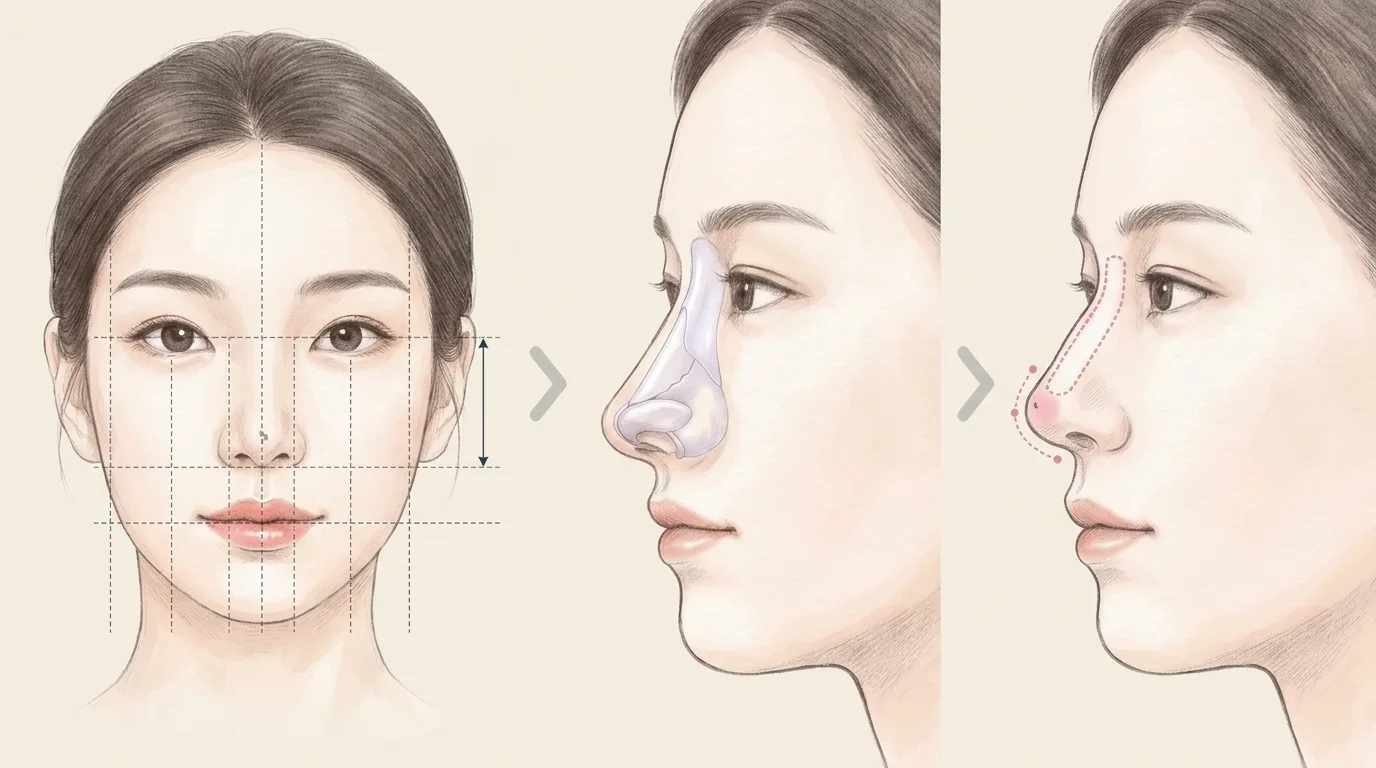
- Left imageEye height, nose height, lip height, 1/5 of the face
- Right imageAppropriate height, natural nose line, suitable angle
Rhinoplasty by type
We create a clear and pretty nasal bridge that naturally harmonizes with the entire face.
Choose a differentiated nose surgery method according to the patient’s condition, and create a natural yet beautiful nasal line with a customized procedure.
It is categorized into Low Nasal Bridge, Upturned Nose/Short Nose, Arrow Nose/Long Nose, Deviated Nose, Dorsal Hump, Alar Reduction, and Revision Surgery.
-
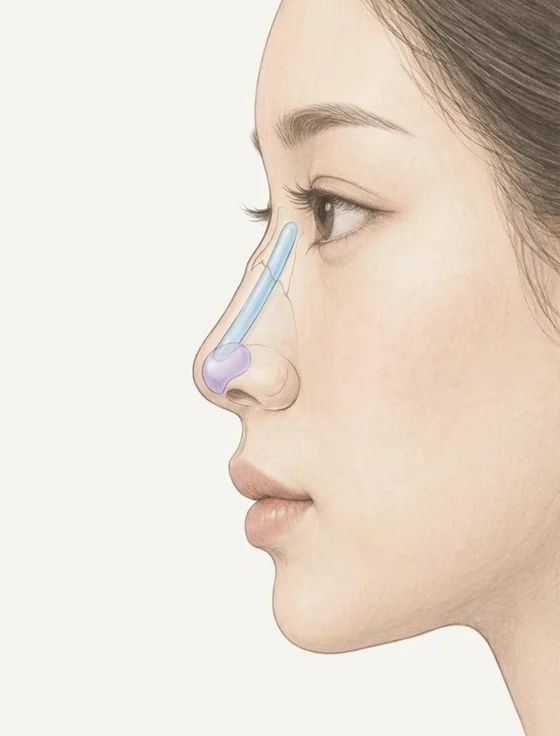 Low Nasal Bridge
Low nasal bridge surgery can be performed in various ways depending on the height and shape of the nose, skin thickness, and overall facial proportions.
-
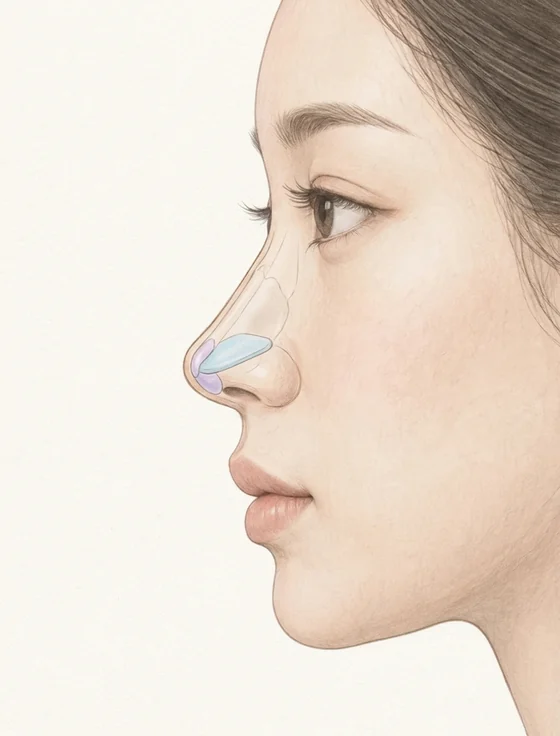 Upturned Nose/Short Nose
An upturned or short nose refers to a shape in which the length of the nose is relatively short or the nasal tip is lifted upward so that the nostrils are highly visible from the front.
-
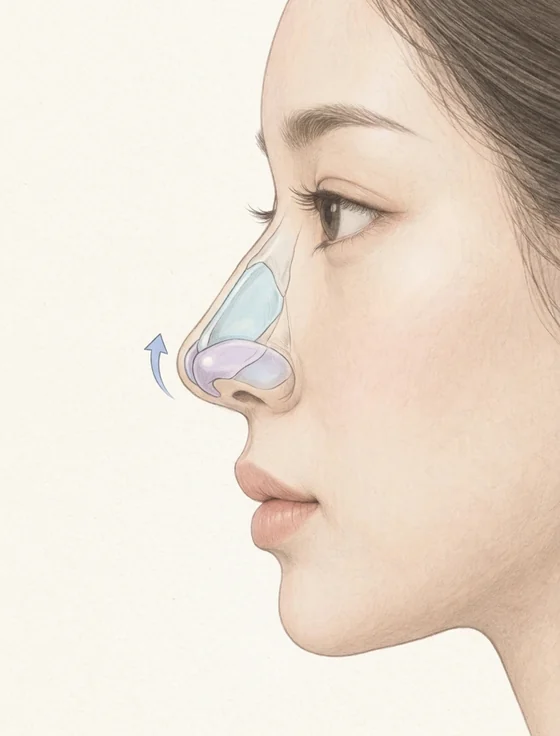 Arrow Nose/Long Nose
An arrow or long nose refers to a shape in which the nasal tip droops downward or the length of the nose appears long relative to the face.
-
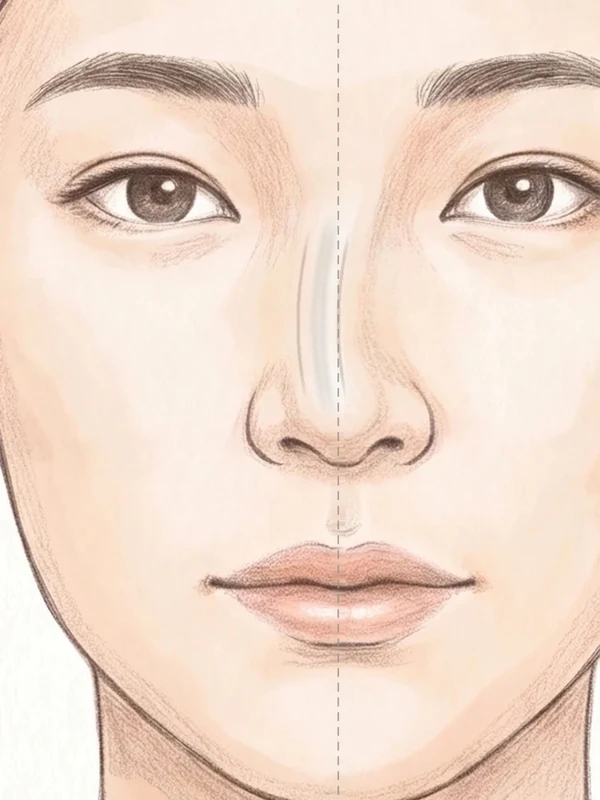 Deviated Nose
A deviated nose refers to a shape in which the nasal bridge or nasal tip bends to one side away from the facial midline, making the nasal line appear asymmetric.
-
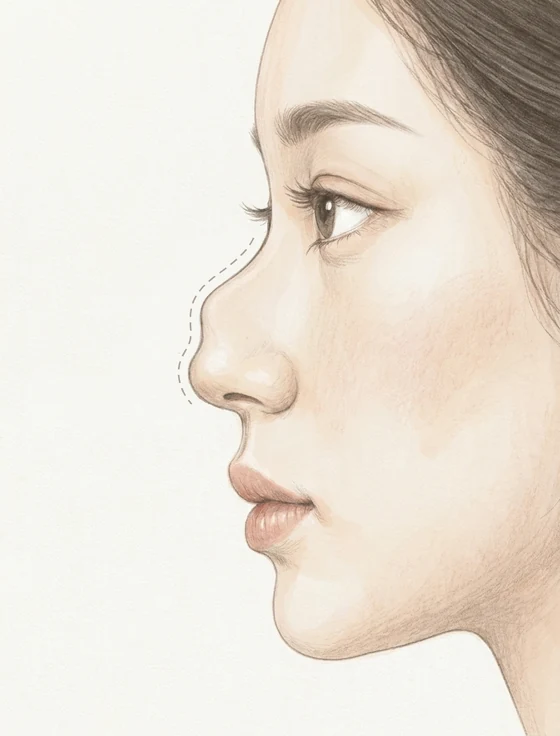 Dorsal Hump
A dorsal hump refers to a shape in which the nasal bone and cartilage forming the nasal dorsum are overly developed or protruding, so that the middle portion of the nasal dorsum appears bulged in profile.
-
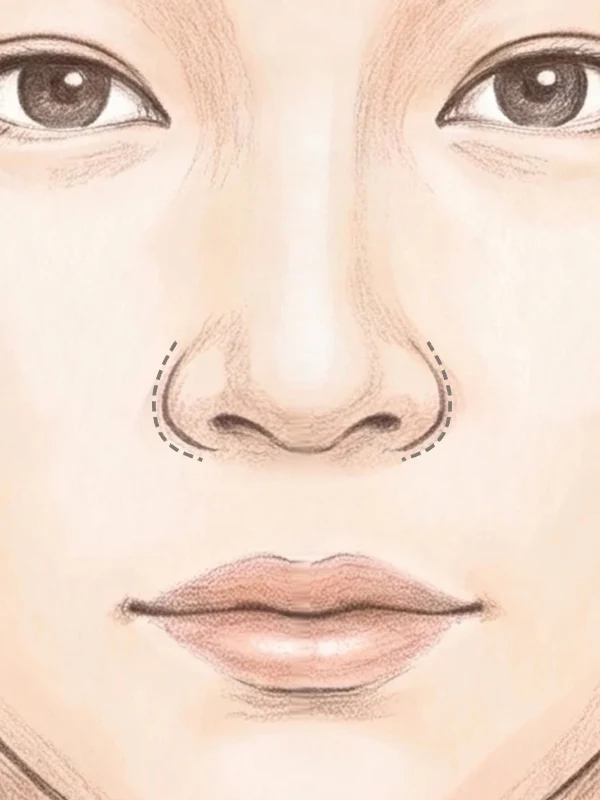 Alar Reduction
Alar reduction is a surgery that adjusts the width and shape of the alar to create a more balanced nose shape when the alar is widely spread to the sides or the nostrils appear large, making the nose look wide and blunt.
At a Glance
Rhinoplasty is surgery to correct the shape of the nasal bridge, nasal tip, and alar base, and revision surgery is performed after first checking prior surgical history and tissue status. The cartilage supporting the nasal tip is selected among septal cartilage, ear cartilage, and rib cartilage (autologous/donor) according to the required support.
Rhinoplasty, what should be checked first?
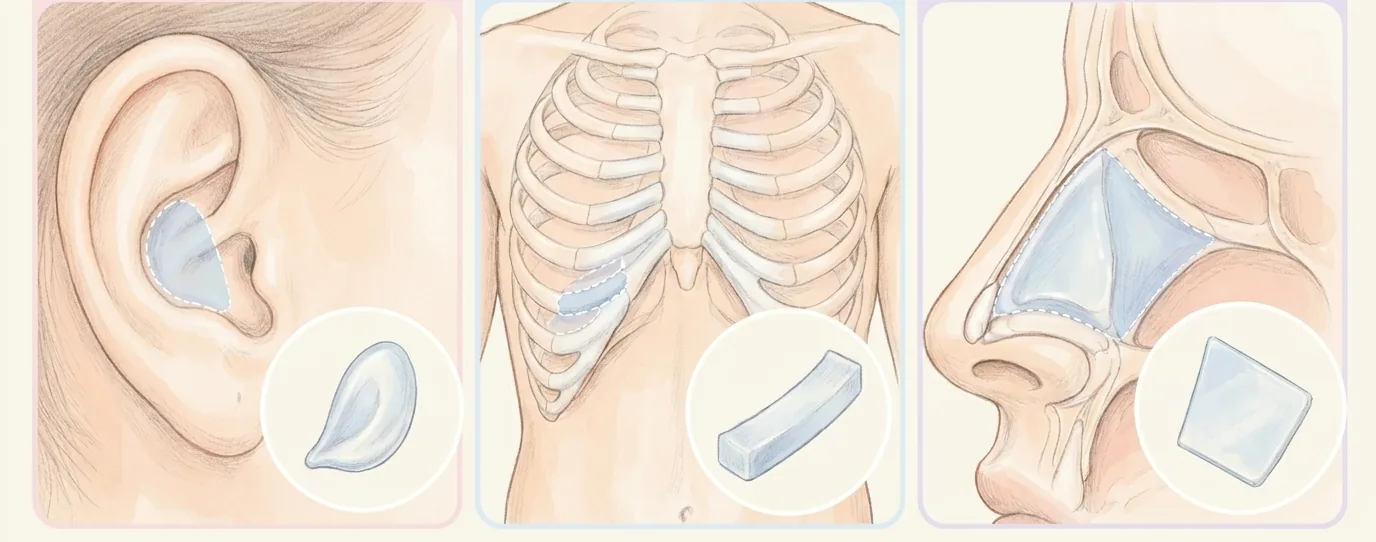
Technical capability to handle various autologous implants
ImageUp Plastic Surgery identifies and utilizes the characteristics of various autologous cartilage based on anatomical know-how.
- Nasal bridge reconstruction using temporalis fascia
- Nasal tip reconstruction using ear cartilage
- Nasal tip reconstruction using autologous rib cartilage
- Shaping of the nasal bridge and tip using one’s own dermis (autologous dermis)
- Shaping of the nasal tip using septal cartilage
Rhinoplasty/Revision Surgery — KakaoTalk 1:1 consultation
If you are curious about your previous surgical history or your current nose condition, you can inquire via KakaoTalk before consultation.
How is a natural-looking nose shape created?
Natural-looking nose surgery does not simply make the nose lower or higher; it aims to correct deficiencies while maintaining the original nose-to-face proportions. It considers the height from the forehead to the bridge, the position and angle of the tip, and the degree of projection of the lips and chin together.
If the bridge is raised excessively, the line from the forehead to the nose can look unnatural or the nose may appear to stick out separately from the face. Especially when the skin is thin, the contours of the implant or cartilage may show, so the height is discussed to match skin thickness and facial proportions.
Nose lines that harmonize with Korean faces
A Plastic Surgery Specialist (Korea) designs a nose shape that harmonizes with the entire face by considering the lines of the nose and forehead, the distance between the eyebrows, and the angle with the lips.
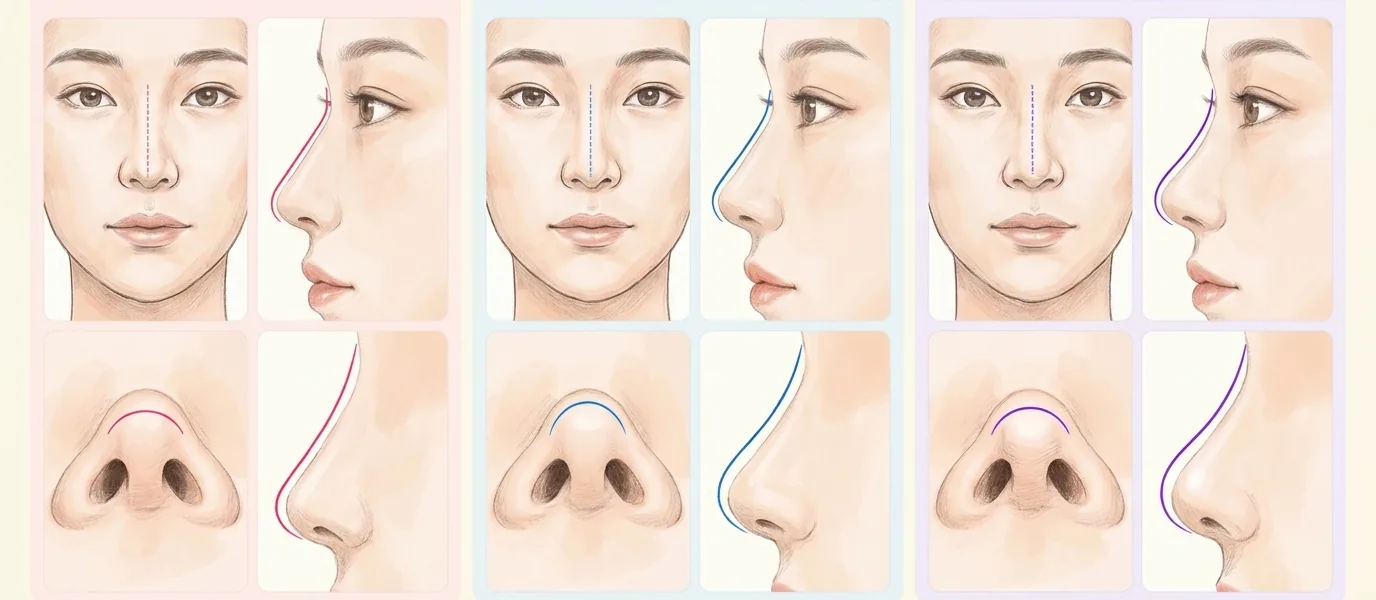
Choose the bridge line—ban-beoseon line, straight line, straight–ban-beoseon line—according to each person’s aesthetic criteria and face shape.
| Natural straight nose line | A natural, straight line for a neat and refined image |
|---|---|
| Natural straight–ban-beoseon nose line | A defined bridge and tip shape for a feminine yet refined image |
| Natural ban-beoseon nose line | A defined bridge and rounded tip for a feminine yet cute image |
Revision Rhinoplasty
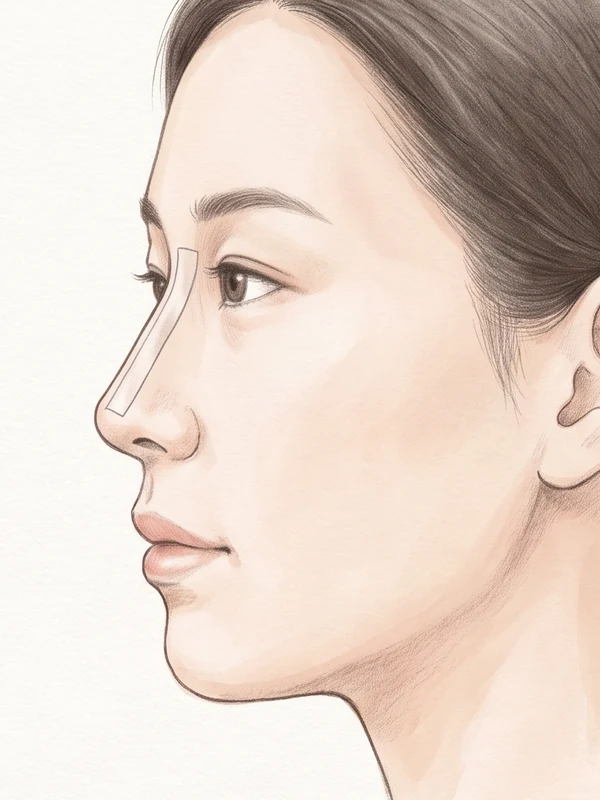
Revision rhinoplasty is surgery performed when, after a previous rhinoplasty, the shape of the nasal bridge or tip is unnatural or asymmetry has developed, or when further correction is needed due to implant malposition or showing through, nasal tip deformity, contracture, or similar issues.
3D CT & Precision Analysis
We proceed with surgery after precision scanning for accurate, three-dimensional analysis.
ImageUp Plastic Surgery considers the combined factors of the patient’s skin, muscles, and skeletal structure before surgery to proceed with surgery tailored to the individual and patient safety.
Why is 3D-CT necessary in rhinoplasty?
- Detailed analysis
- Deviated septum symptom check
- Identify internal tissues
- Establish an accurate surgical plan
Frequently Asked Questions
On day 9 after nose surgery, if I want to have alar reduction once more, do I need to wait 6 months?
Question details: It’s about day 9 after tip simple augmentation (septal cartilage) and dorsal silicone implant surgery. Because I had a bulbous-nose look, I also had Alar Reduction, but my nose still looks big, so I want to have Alar Reduction once more. I’m wondering whether this would be classified as nose revision surgery.
At day 9, you still need to watch the course. Significant swelling takes at least about 2 weeks to subside, and it takes at least 6 months for the shape to settle. Try not to rush; take your time.
On day 11 after nose surgery, I hit my alar area—could this cause infection or change the shape?
Question details: I was looking at my phone and dropped it, hitting the alar area.
If there is no trauma or other symptoms such as persistent pain, there is unlikely to be a serious problem, so please observe the progress, and if it gets worse or lasts a long time, visit us to have it checked. If swelling develops at the injured site or you suspect infection, it is advisable to be examined.
If you press or pick your nose, does the nose get lower or larger?
Question details: When I occasionally pick my nose, my finger goes into the nostril and it feels like the nostril or nose gets bigger, so each time I press the nose firmly a few times. When I press hard, I hear a slight squishing sound; if I do this, does the nose get lower or larger, and is it true that picking the nose makes the nostril bigger?
Pressing or picking the nose to that extent does not change the shape, because the nose is supported by bone and cartilage. However, if strong stimulation is applied repeatedly, the skin or soft tissue can be damaged.
After nose surgery, can wearing a mask cause inflammation in the nose?
Question details: It has been about 3 months since my nose surgery. I had a dorsal silicone implant, septal cartilage tip work, and Alar Reduction.
Simply wearing a mask does not cause problems at the surgical sites. You do not need to worry much.
I had nose surgery using ear cartilage; is cartilage show-through common?
Question details: I had nose surgery 4 days ago. Because I had surgery for a deviated septum previously, this time it was done using only ear cartilage. After surgery I saw on various communities that cartilage can show through, so I am worried. Is cartilage show-through a common issue, or is it more common that it does not occur?
It can occur if the nasal skin is very thin or if the tip was raised excessively. Depending on the surgical method, the probability varies, but when ear cartilage is used, the likelihood of cartilage showing through is relatively a bit lower. People with very thin nasal skin may have their existing cartilage show through even without surgery; they simply may not have recognized it before surgery. Conversely, those with thick skin and abundant tissue rarely show through even after surgery. If the nose was not raised excessively, you do not need to worry greatly.
Two months after Rhinoplasty, my nasal bridge throbs and tingles—could this be inflammation?
Question details: It has been a little over two months since Rhinoplasty. For the past week, I have felt a throbbing and tingling sensation on the bridge about 2–3 times per hour. There is no swelling or tenderness on touch. I am anxious whether this is a foreign-body sensation from the implant and whether this could lead to infection.
When there is inflammation, findings such as pain, heat sensation, swelling, and color changes at the surgical site appear. If you only have sensations without such findings, mild pain can occur as scars stabilize after surgery.
On day 3 after Rhinoplasty, the tip looks bluish—is this a bruise or a complication?
Question details: It is day 3 after Rhinoplasty, and the tip color is slightly different and looks bluish like skin with no blood flow. I wonder if this is normal. I had a dorsal silicone implant, septal cartilage tip, and Dorsal Hump osteotomy.
On postoperative days 2–3, swelling is at its peak, so the skin may look a different color, and in most cases slight color change is not an abnormal finding. If the skin turns black or a deep purple, there may be decreased blood circulation. However, in most cases it recovers as the swelling subsides, so you don’t need to worry too much.
On day 5 after Rhinoplasty, it is swollen like an “avatar nose”; could this be due to inflammation?
Question details: I am anxious that it might be due to inflammation.
For about 2 weeks after surgery, there is significant swelling. The swelling will decrease a lot from what you see now, so you do not need to worry.
From what age can nose surgery be done?
It is best to have nose surgery after nasal bone growth is complete. Because the nasal bones can grow until around adulthood, it is possible from around age 18.
After a fall, the lower part of my nose hurts and is swollen—should I go to the hospital?
Question details: I think I fell after drinking. The bridge looks fine, but when I touch the lower cartilage part of the nose it hurts a little, and although there is no visible difference on the surface, on palpation it feels hard and swollen. It has been about 2 days, and it hurts when touched while washing my face. 1. Should I go to the hospital or will it get better if I leave it? 2. If I should go, which kind of clinic should I visit? 3. What tests would be done at the hospital?
If pain and swelling persist, it is advisable to be evaluated. Visit a plastic surgery clinic where imaging diagnosis is available and undergo X-ray, CT, etc. Because the nasal bones are thin, they can fracture even from bumping into a door. If there is a fracture, you may not recognize it while swollen, but after the swelling subsides, there may be deformity of the nose shape, so I recommend getting a diagnosis.
Eight months after nose surgery, I hit between the eyebrows and got bruised and swollen—could this cause a complication?
Question details: I am worried it might be inflammation.
If the injured area and the operated area have severe swelling with heat sensation and pain that is worsening, there may be a problem. If these symptoms are absent and there is only slight swelling, you do not need to worry much.
On day 16 after eye and nose surgery, is it okay to cough while scrunching my face?
Question details: It is day 16 since I had Ptosis Correction plus Upper Eyelid Canthoplasty, Lower Eyelid Canthoplasty, and Lateral Canthoplasty, and nose surgery. When I fail to hold back a cough, I end up scrunching my face and squeezing my eyes shut. With ptosis correction, my eyes feel tight, and when I cough it feels very tight and as if they might flip—will this not come undone? I also coughed hard while frowning for the nose; is that okay?
You cannot completely avoid coughing after surgery. Please observe the progress, and if it gets worse or lasts a long time, visit us to have it checked. At around 16 days, there is little to worry about. Early after nose surgery you should be careful with sneezing, but scrunching the face to that extent is fine.
After Dorsal Hump surgery, can a revision be done by adding only osteotomy?
Question details: I had Dorsal Hump surgery last October under partial anesthesia and via a non-incisional approach. The protruding hump was removed, but because they said the shaved surface was not wide, no osteotomy was performed; the tip was corrected with cartilage repositioning and cartilage tying. After the swelling subsided, from a full side view it is straight, but the sides of the nasal dorsum protrude so at a 45-degree angle it still looks like a hump, and on the front view the shaved portion of the dorsum looks wide like a trapezoid. 1. By narrowing with osteotomy, can the protruding sides and dorsum be corrected? 2. If I add only osteotomy, will it affect the tip?
1. If the nasal bones still look wide on the front view even after hump removal, osteotomy can improve it. Also, osteotomy reduces the shape of both sides of the nasal bones, so the bone width decreases and, as a result, the dorsum may appear slightly higher. 2. Osteotomy has little effect on the tip.
How do I decide on a nose shape that suits my face?
Question details: I wonder if this is discussed during consultation. I do not want to end up with an “avatar nose.”
The desired nose shape matters, but you should also consider the face’s length and width, the degree of forehead and lip projection, and the existing nose’s height and length. Rather than copying a specific celebrity’s nose, it is important to find a bridge height and tip shape that look natural on your own face.
Is a higher nasal bridge always more attractive?
Question details: My friends say that if I make it low I will regret it one hundred percent and tell me to make it high.
Not necessarily. If the bridge is made excessively high, the line from the forehead to the nose can look unnatural, or the nose may appear to stick out from the face. Especially when the skin is thin, the implant may show through or its contours may become visible, so it is better to set the height to match skin thickness and facial proportions.
Three months after nose surgery, my tip seems to have dropped. Do I need revision surgery?
Question details: I’m wondering if the tip drops again after nose surgery. It has been 3 months since surgery, and the tip seems a bit lower. I asked not to make the tip too high during surgery, and I regret it.
Immediately after surgery, due to swelling and tissue tension, the tip can look slightly higher, and it settles naturally over time. It is hard to say all of this is tip droop. However, if the original tip support is weak or the skin is thick and heavy, surgery should account for long-term changes. At 3 months, swelling and scars have not fully matured, so it is better to continue observation.
Do I have to remove the silicone placed in the nose later on?
Question details: I wonder if it can stay for life. I heard that the implant must be changed after a few years.
If there are no particular problems, it does not have to be removed or replaced just because a certain time has passed. However, if issues such as infection, implant migration, or implant show-through due to skin thinning occur, removal or revision surgery may be necessary.
For tip surgery, should I use ear cartilage or rib cartilage?
Question details: Do you always have to use ear cartilage for the tip, or are there cases where rib cartilage is needed? During consultations, one clinic said ear cartilage must be used, while another said rib cartilage is absolutely required, so I don’t know which is correct.
The same cartilage is not used for every patient. Depending on the needed tip height and support, the amount of existing septal cartilage, and any prior surgery, septal cartilage, ear cartilage, or rib cartilage can be selected. Especially in revision cases or when much support is required, rib cartilage may be considered.
When is the most appropriate time for revision rhinoplasty?
In general, after 6 months following the first surgery is most appropriate.
After nose surgery, are the nostrils packed?
Question details: I also wonder if swelling makes it hard to breathe. A friend who had surgery said the hospital packed the nose, which was difficult and made it hard to breathe.
In the early postoperative period, the inside of the nose can swell and produce secretions, commonly causing a stuffy sensation. Most improve as swelling decreases. However, if you had preexisting nasal obstruction from a deviated septum or rhinitis, or if congestion persists after surgery, it is good to check the internal nasal structures. And typically, when a procedure uses septal cartilage, the nose is packed; when ear or rib cartilage is used, the nose is not packed. If the nose is packed, the first 3~4 days can be a bit uncomfortable.
At one month after surgery, the bridge looks high and the tip looks upturned. Will it set like this?
Question details: The bridge looks too high and wide, and the tip looks upturned. Do I need a revision?
Right after surgery, due to swelling, the bridge and tip may look higher than expected, or the tip may appear upturned. As swelling subsides and the skin and soft tissue adapt to the new nasal framework, the shape continues to change, so it is better not to judge the final result too early.
I didn’t originally have a Deviated Nose, but after nose surgery my nose looks slightly crooked. Is this due to swelling?
Early on, uneven swelling on the left and right can make the nose look crooked. If the original nasal bones or septum are asymmetric, a slight asymmetry can also remain after surgery. If the degree of curvature is still apparent after swelling has sufficiently subsided, it is best to have it checked in a consultation.
After nose surgery, when can I wear glasses?
Question details: I also wonder whether I can touch or blow my nose.
In the early postoperative period, it is important not to apply strong pressure to the nose. In particular, if nasal bone surgery was also done, be more cautious with items like glasses that continuously press on the nasal bridge. Avoid blowing your nose forcefully or massaging it, and follow guidance on when these are possible based on the surgical method and your recovery.
After nose surgery, with what symptoms should I contact the hospital immediately?
Question details: I also wonder whether nose surgery is very painful.
After surgery, swelling, bruising, nasal congestion, or mild pain can occur. However, if pain or swelling worsens over time, if the nose becomes very red and warm, if discharge like pus appears, if the skin color changes abnormally, or if there is persistent heavy bleeding, it is advisable to contact the hospital for evaluation.
My bulbous tip is on the severe side; can nose surgery make the tip slim?
Question details: It’s a bulbous tip like a Hallabong.
A bulbous tip is not simply due to a low tip; multiple factors such as the shape and splaying of the tip cartilages and the thickness of the skin and subcutaneous tissue act together. Therefore, in some cases raising the tip alone is sufficient, but in other cases the cartilage shape needs correction or the tip volume should be appropriately reduced. If the skin is very thick, there can be limits to making a very thin and sharp tip with surgery alone.
I heard that if you shave a Dorsal Hump, the hump grows back later. Can the bone grow again?
In adults, it is not typical for removed nasal bone to regrow and return to the original hump shape. However, during bone healing after surgery, fine irregularities can be felt, or the contours of remaining cartilage and bone can make it seem as if the hump has come back.
With Alar Reduction, are scars very noticeable?
Question details: My alae are very wide, and I’m worried about whether to have surgery because of scarring.
Depending on the Alar Reduction method, the incision location varies, and incisions are often made inside the nose or at the junction where the ala meets the face. Early on, the incision line can look red or feel firm, but it often fades over time. However, depending on skin characteristics, a noticeable scar may remain.
I heard that as a side effect of nose surgery, contracture can occur. What exactly is contracture?
After nose surgery, due to infection or repeated surgeries, severe scarring and contraction can form inside the nose, leading to deformities such as a shortened nose or an upturned tip; this is commonly called contracture. It does not occur in every nose surgery, but if there are symptoms suggesting infection, it is important to seek evaluation early.
In rib cartilage nose surgery, how are autologous rib and donated rib different?
Question details: In consultation, I was told my bridge is so low that rib cartilage is needed. I also wonder which is better.
Autologous costal cartilage uses your own rib cartilage harvested for use, and donated costal cartilage uses a donor’s cartilage that has undergone appropriate processing. Autologous rib has the advantage of being your own tissue, but it requires an additional operation and scar on the chest area. Donated rib does not require a separate harvesting operation, but the possibilities of absorption or deformation should be considered together. Neither one is better for every patient; it is chosen based on the needed support, the surgical goal, and the status of any previous surgery.
Why do I usually have to wait before Revision Rhinoplasty?
Right after surgery, swelling remains, and scar tissue forms inside the nose with ongoing changes. If it is too early, it is difficult to accurately assess the actual nasal shape, and the tissues are not stabilized, which can make revision more difficult. If there is no issue that requires particularly early surgery, revision is often considered after the tissues have sufficiently stabilized.
One month after nose surgery, the tip feels hard—will it stay this hard?
Question details: My nasal tip is much harder than before surgery and doesn’t move well.
In the early period after surgery, swelling and scar tissue can make the nasal tip feel firm with limited movement. Over time, it often becomes somewhat softer, but depending on the cartilage used and the method of supporting the nasal tip, it may not become exactly as soft as before surgery.
After nose surgery, will I never be able to press the tip to make a “pig nose” again?
Question details: I was told not to do it after surgery.
If cartilage is used to support the nasal tip and it is structurally fixed, movement of the tip may be more limited than before surgery. In particular, it is best to avoid forcefully pushing the tip upward. Over time it may look more natural to some degree, but the degree of movement varies depending on the surgical method.
Can nose surgery be done to look natural without looking like I had surgery?
Question details: I want surgery, but I really don’t want it to look obvious.
It is possible. A natural-looking rhinoplasty is not simply making it lower; it is important to appropriately correct deficient parts while maintaining the proportions of the original nose and face. By considering the height from the forehead to the nasal bridge, the position and angle of the nasal tip, and the projection of the lips and chin together, a plan can be made for natural changes that do not make the surgery look obvious.
When can I know the final result of nose surgery?
Question details: I’m also wondering if all the swelling is gone by one month. I don’t know how long I should take off work after surgery, and I don’t want people to notice I had surgery.
Around one month, much of the initial major swelling may have decreased, but it is difficult to regard this as the final look. In particular, swelling at the nasal tip can persist relatively longer, and if the skin is thick, changes may occur more slowly. As the internal scar tissue and skin settle, the shape can gradually look more natural over several months. After surgery, the operated area is taped and stabilized with a splint. Stitches, the splint, and the taping are usually removed in about one week. Major swelling lasts about 1–2 weeks, but daily activities are possible immediately after surgery, so you can adjust your schedule accordingly.
Depending on the individual, side effects such as bleeding, infection, swelling, asymmetry, and scarring may occur, and the degree may vary. Please make your decision after sufficient consultation with a specialist.
Rhinoplasty/Revision Surgery — KakaoTalk 1:1 consultation
If you are curious about your previous surgical history or your current nose condition, you can inquire via KakaoTalk before consultation.