

Breast Surgery
We examine body shape and tissue condition together and provide consultation
Breast augmentation is a surgery that corrects the size and shape of the breasts by inserting a breast implant. At ImageUp Plastic Surgery, after checking the width of the ribcage, the amount of breast tissue, and skin thickness, we determine the incision site (armpit·areola·inframammary fold) and the layer where the implant is placed (under the muscle·over the muscle, etc.) through consultation. Rather than simply targeting a desired cup size, we use breast width and projection suitable for the body as the standard. In addition to breast augmentation, we also consult on breast reduction, breast ptosis correction, nipple correction, areola correction, inverted nipple correction, large nipple correction, breast reconstruction, and revision breast surgery. Cup size cannot be determined by implant size (cc) alone, and results vary depending on body shape and tissue condition.
Breast Surgery, what is checked in a consultation?
Balance between breast size and body shape
We look not only at breast size but also at the overall proportions of the body, including the width of the shoulders and ribcage, the waist, and the pelvis.
Condition of the skin and breast tissue
We check the elasticity and thickness of the skin, the amount of existing breast tissue, and the degree of sagging, and then decide on the appropriate surgical method.
Breast position and left-right asymmetry
We check the position of the nipples and the inframammary fold, and differences in size and height between the left and right breasts.
Desired size and shape
Rather than deciding only how many cc of implant to use, we discuss together the volume you want, the breast width, the degree of projection, and the shape of the upper and lower breast.
Breast Surgery — KakaoTalk 1:1 consultation
If you share your body shape and desired volume in advance, consultation is available via KakaoTalk before the visit.
Types of Breast Surgery
Browse by type of Breast Surgery
Breast surgery is consulted on in four groups: breast augmentation, breast reduction, breast ptosis correction, and other breast surgery.
Breast augmentation
Breast augmentation uses implants to add volume to a breast that lacks it and to create a breast shape that is in harmony with the body.
Implant size alone does not determine the result of surgery. The width, projection, and shape of the implant must be considered together with the thickness of the existing breast tissue, the width of the ribcage, skin elasticity, and the position of the inframammary fold.
Depending on your individual anatomy and the breast shape you want, the type and size of the implant, the placement position, and the incision method are decided.
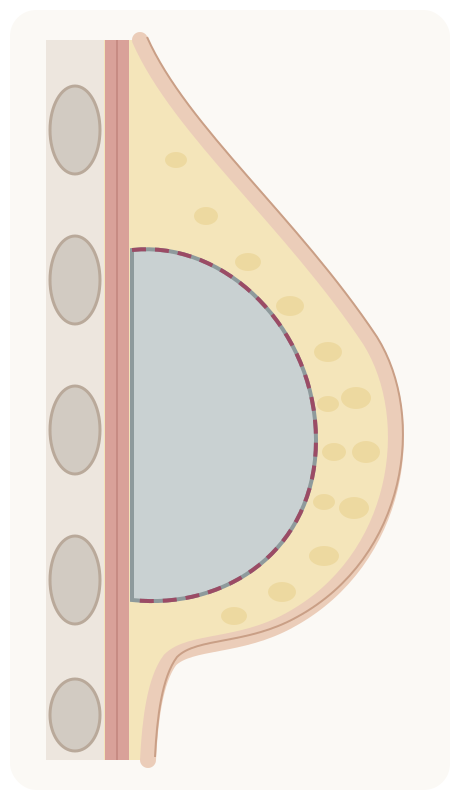
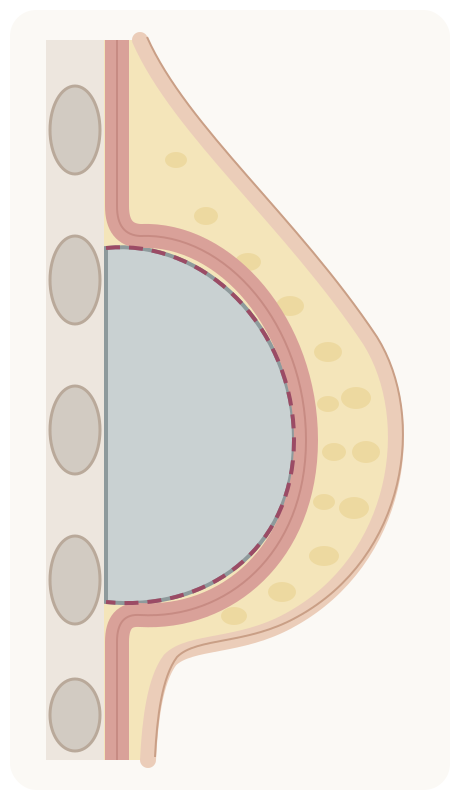
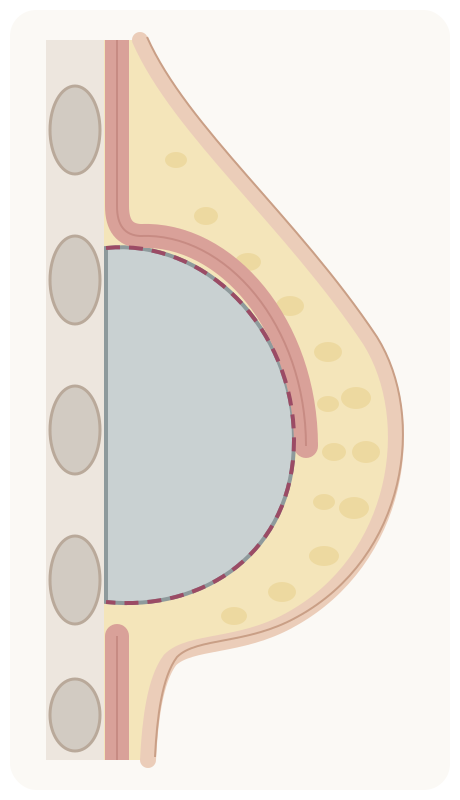
Where is the implant placed?
The breast implant is placed in a suitable position after considering the amount of existing breast tissue, skin thickness, and the shape of the pectoralis major muscle.
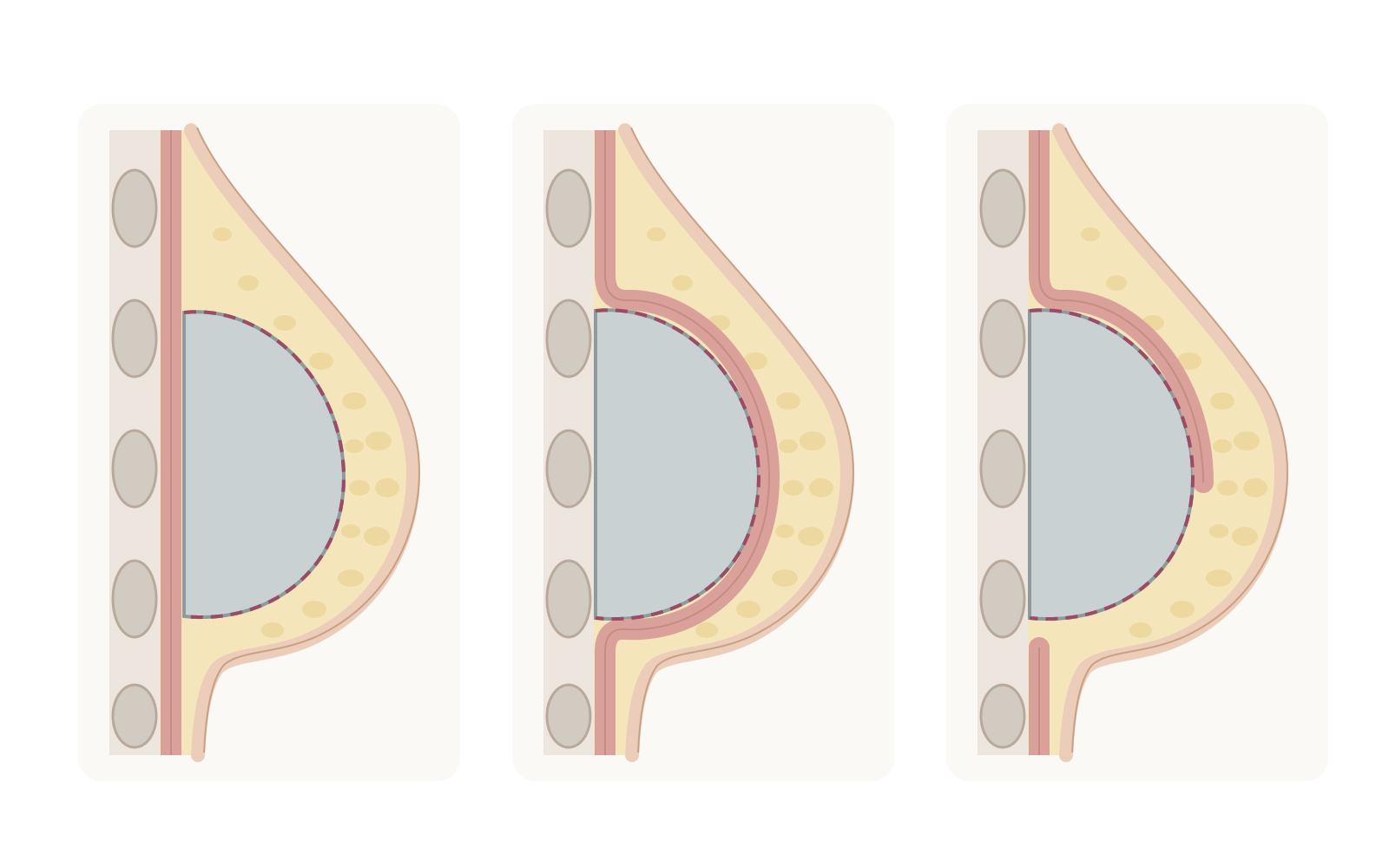 Subglandular placement
 Submuscular placement
 Dual plane
Subglandular placement
This method places the implant below the breast tissue and above the pectoralis major muscle. It can be considered when there is enough existing breast tissue.
Subfascial placement
This method places the implant under the fascia that covers the pectoralis major muscle.
Submuscular placement
This method places part or most of the implant under the pectoralis major muscle. When the soft tissue is thin, it can help reduce the visibility of the edge of the implant.
Dual plane
In the upper part of the breast the implant lies under the pectoralis major muscle, and in the lower part the space is adjusted so that it connects naturally with the breast tissue.
No single method is best for everyone. The placement position is chosen according to the thickness and sagging of the breast tissue, the shape of the ribcage, and the breast shape you want.
Where is the incision site?
To insert the implant, an incision is needed. The incision site is decided by considering the shape of the breast, the surgical method, and the type of implant.
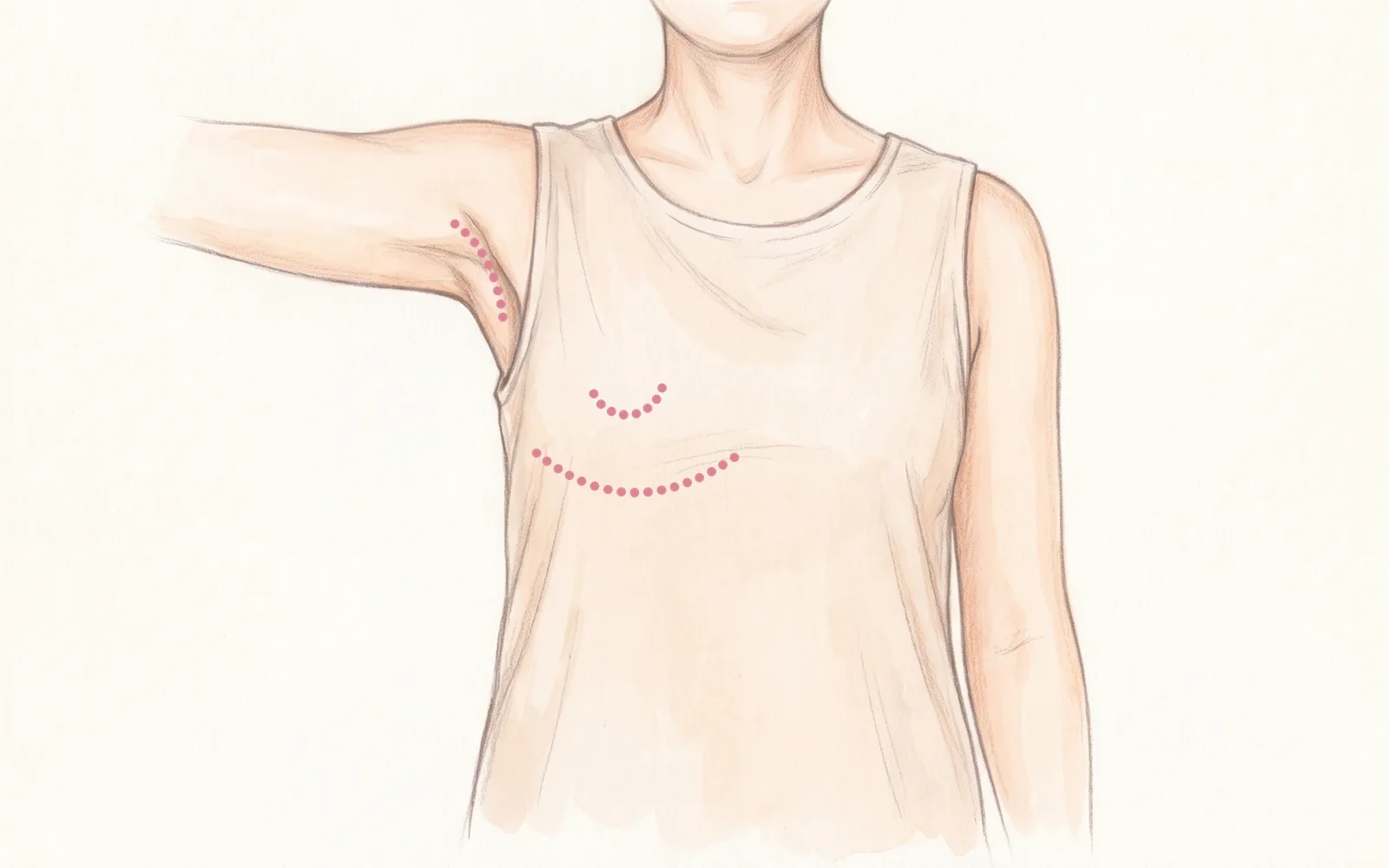
Inframammary fold incision
This method cuts along the natural fold below the breast. While directly checking the surgical area, the space for the implant and the position of the fold can be adjusted.
Armpit incision
The incision is made using the natural crease of the armpit. The characteristic is that no incision line remains on the breast itself.
Areolar incision
This method cuts along the border between the areola and the surrounding skin. It can be considered selectively depending on the size of the areola and the purpose of surgery.
Each incision site has its own advantages and disadvantages, so it is important to choose by considering the accuracy of surgery, the shape of the breast, and the type of implant together, rather than deciding on the scar alone.
How is breast augmentation carried out?
- 01
We analyze your body shape and breasts
We check the width and shape of the ribcage, the size and tissue thickness of the existing breasts, the position of the nipples and inframammary fold, and left-right asymmetry.
- 02
We decide the implant and surgical method
Based on the size and shape you want, we decide the width and projection of the implant and plan the placement position and incision method.
- 03
We create the space for the implant
Through the planned incision, the tissue is dissected to create a space where the implant can sit stably.
- 04
We insert the implant and check its position
After inserting the implant, we check the left-right height, the width of the breast, the inframammary fold, and the overall shape.
- 05
We close the incision
After checking the position of the implant and the left-right balance, the incision is closed in stages to finish.
How is the implant size decided?
The size of the implant is not decided by the cc you want alone.
Even with the same volume, the actual shape of the breast can look different depending on the width and projection of the implant. The width of the ribcage, the amount of existing breast tissue, and how far the skin can stretch must also be considered.
Therefore, at the consultation we check the size you want and, at the same time, consider the diameter and projection of the implant that fit the width of your breast, and decide on a size that suits your body shape.
What care is needed after breast surgery?
In the early period after surgery, swelling, bruising, a feeling of tightness, or temporary changes in sensation may appear.
After implant surgery, while the implant settles stably, it is best to keep an appropriate posture and range of activity according to the medical staff's guidance, and to avoid strenuous upper-body exercise or actions that put strong pressure on the surgical area.
After surgery, the condition of the wound, the position of the left and right breasts, and the state of the implant are checked regularly, and tests such as ultrasound can be performed when necessary.
The final shape of the breast settles naturally over time, as swelling decreases from right after surgery and the skin and tissue adapt to the new form.
Breast implants are made very durable, but they are not products that never become damaged, so there is a possibility of rupture over time. It is not mandatory to replace them just because exactly 10 years have passed, but it is important to regularly check their condition.
You can receive breast cancer screening even with implants; inform the testing facility that you have implants, and breast ultrasound·MRI may be used together as needed. If, without a specific reason, one breast suddenly becomes swollen or pain becomes severe after surgery, it is advisable to get examined.
Breast reduction
Breast reduction reduces the discomfort caused by excessively large breasts and adjusts the breasts to a size and shape that suit the body.
By reducing excess skin and glandular and fatty tissue and adjusting the position of the nipple and areola, the overall shape of the breast is reconstructed.
Depending on the size and degree of sagging of the breast, the amount of tissue to be removed and the incision method differ.
Breast reduction surgery is divided by incision method into areolar incision, vertical incision, and ‘ㅗ’-shaped incision.
Breast ptosis correction
Breast lift to correct sagging breasts
When the skin and breast tissue sag downward because of pregnancy and breastfeeding, weight changes, or aging, the volume of the upper breast decreases and the position of the nipple may also drop.
Breast lift adjusts loose skin and repositions the breast tissue and nipples to improve the shape of sagging breasts.
If the current breast volume is sufficient, only a lift can be performed; if the volume is lacking, implants or fat grafting can also be considered together.
How is breast ptosis judged?
Breast ptosis is different from simply having small breasts or lacking volume in the upper breast.
In general, the degree of sagging is evaluated by checking together the relationship between the position of the nipple and the inframammary fold and how far the breast tissue has descended.
When the sagging is mild, implants alone may improve the shape to some extent, but when the skin and breast tissue sag considerably, implants alone are hard to solve it and a breast lift may be needed.
Other Breast Surgery
Breast concerns are not only about size; they can appear in many ways, such as the size and shape of the nipple and areola, inversion, and left-right asymmetry. Depending on your current condition and the change you want, the necessary surgery can be chosen and carried out.
Nipple correction
When the nipple is large or protrudes long, its size and height are adjusted so that it is in harmony with the breast.
Areola correction
When the areola is large or differs in size and shape between the left and right, its size and shape are adjusted.
Inverted nipple correction
When the nipple is turned inward or does not protrude enough even when stimulated, the degree and cause of the inversion are checked and the nipple is corrected so that it can protrude naturally.
Large nipple correction
When the length or width of the nipple is excessively large, unnecessary tissue is reduced and the overall size and shape are adjusted.
Breast reconstruction
When the shape of the breast has changed because of breast surgery or trauma, the remaining tissue and skin condition are evaluated and the shape of the breast is reconstructed.
Each surgery is decided by considering together the shape of the nipple and areola, the condition of the skin and breast tissue, and future breastfeeding plans.
Revision breast surgery
If there is Capsular Contracture, implant rupture, or malposition, revision surgery may be necessary, but if it is simple aging or sagging, procedures such as a breast lift may be more important than replacing the implant. The decision is made after checking both the current implant and the condition of the breast tissue.
Frequently Asked Questions
With Breast Surgery, how many cup sizes can I go up?
Question details: I’m also wondering if it can be made to the cup size I want.
Volume can be increased depending on the implant size and chest circumference, but even with the same implant, the final cup size varies by person. The existing breast size, ribcage width, skin laxity, and the amount of breast tissue should be considered together. Rather than simply targeting a desired cup number, it is better to choose an implant based on breast width and projection that suit your body type.
My friend got a small breast implant and regrets it—are larger implants always prettier in shape?
Using a larger implant does not necessarily create a better shape. If an implant larger than what your ribcage and breast tissue can accommodate is used, issues such as visible or palpable implant edges, skin thinning, or breast sagging may occur. It is important to choose a size that matches your body type and tissues.
How many cc are needed to become a C cup or D cup?
It is difficult to predict the final cup size accurately based on implant cc alone. Even at the same 300cc, the apparent size differs in people with narrow versus wide ribcages, and it is also influenced by the amount of existing breast tissue. Therefore, rather than focusing on cc itself, choose while considering breast width, implant height, and projection together.
There are so many types of implants—which implant is the best?
There is no single implant that is best for everyone. Each implant differs in width, height, projection, and the characteristics of the surface and filler, so selection is made considering ribcage size, existing breast tissue, and the desired shape. Choosing a size and shape suitable for your body type is more important than the name of a specific product.
After Breast Surgery, will the implant be very noticeable to the touch?
Question details: I’m planning surgery to have fuller breasts than now, but I’m worried it will be very obvious. I’m also wondering if it can feel soft like a natural breast.
Tactile feel is greatly affected not only by the implant itself but also by the thickness of your own breast tissue and fat covering the implant. If the original breast tissue is sufficient, the implant edges may be less noticeable, but in a very thin body type the implant may be more easily felt. It cannot be guaranteed to have exactly the same feel as a natural breast.
Is it better to place the implant under the muscle or over the muscle?
No single position is always better. If your breast tissue is thin, having the muscle provide additional coverage over the implant can help, and if tissue is sufficient, another position may be chosen. Recently, methods that appropriately use both the muscle and breast tissue depending on chest structure are also used. The decision is made considering body shape, tissue thickness, and the desired shape.
I saw that breast surgery incisions can be in the armpit, along the inframammary fold, or around the areola; which incision is best?
Each has advantages and disadvantages. An armpit incision leaves no scar on the breast itself, and an inframammary fold incision allows direct visualization of the pocket during surgery. An areolar incision can use the areolar border but requires consideration of areola size and breast tissue condition. The incision site is determined by considering the type and size of the implant and whether it is a revision surgery.
If I have surgery through an inframammary fold incision, will the scar be very visible?
Question details: I am scheduled for an inframammary fold approach. I’m worried it will show when I wear a swimsuit.
An inframammary fold incision is planned so the scar sits where the breast naturally folds. It may initially appear red or firm, but in many cases it fades over time. However, scars do not disappear completely and may remain noticeable depending on skin type and the tension placed on the scar.
After breast surgery, can I bring the breasts together to create cleavage?
Cleavage is not determined by implant size alone. The original distance between the two breasts, the width of the sternum, the position of the pectoralis major, and the distribution of breast tissue all have an impact. If someone has a naturally wide gap, forcing the pocket too far inward can look unnatural or cause other problems.
Can I have breast surgery even if my rib cage is asymmetric?
Question details: The front-to-back position of my two breasts is very different. I’m wondering if surgery is possible when the rib cage is asymmetric, like pectus carinatum or pectus excavatum, and whether both sides can be made similar.
It is possible. However, breast shape is influenced not only by breast tissue but also by the ribs and rib cage beneath, so some degree of asymmetry may remain after surgery. Using implants of different sizes or shapes on each side, or adjusting the surgical pocket, can be considered to reduce asymmetry.
My two breasts are originally different in size—can surgery make them completely identical?
Most people have some breast asymmetry before surgery. Differences can be reduced by adjusting implant size or position, but if the rib cage, nipple position, skin, or breast tissue itself differ, making them perfectly identical is difficult. It is important to accurately identify asymmetry before surgery.
For sagging breasts after childbirth or breastfeeding, will they lift just by placing an implant?
Question details: My breasts were originally firm, but after childbirth or breastfeeding they have sagged, and I’m concerned.
If breast sagging is not severe and only volume has decreased, filling the upper breast with an implant may provide some improvement. However, if the nipple has descended significantly and the skin is very lax, simply placing a large implant makes it difficult to resolve the sagging. In such cases, a breast lift can be considered together.
It’s one month after breast surgery, and my breasts sit too high and look hard—is something wrong?
In the early postoperative period, implants can appear high and the breasts can feel firm due to swelling and muscle tension. As recovery progresses, swelling decreases and surrounding tissues soften, and the shape often becomes more natural. Therefore, it is difficult to judge the final result based solely on position and feel immediately after surgery.
After breast surgery, one breast looks higher or larger—what should I do?
Question details: I’m worried they look uneven.
Early after surgery, asymmetry can appear more pronounced due to differences in swelling and muscle tension between sides. Preexisting asymmetry of the rib cage and breasts also affects this. If a clear difference in position or shape remains even after sufficient recovery, it is necessary to check implant position and other factors.
Can sensation become dull or can nipple sensation change after breast surgery?
After surgery, sensation of the breast skin or around the nipple can temporarily become dull or sensitive. In most cases, it gradually improves during recovery, but depending on the extent of nerve involvement, recovery may take considerable time, and in rare cases sensory changes may persist for a long time.
What is capsular contracture that is said to occur after breast surgery?
Question details: I heard that if breast surgery is done poorly, capsular contracture occurs. I’m wondering if it means the breast becomes hard.
When an implant is placed, the body normally forms a thin capsule around it. If this capsule becomes excessively thick and contracts, it can compress the implant, making the breast feel firm, altering its shape, and causing pain; this is called Capsular Contracture. In severe cases, revision surgery may be necessary.
After surgery, can I prevent capsular contracture by doing a lot of massage?
Breast massage is not required for all implants and surgical methods. Capsular Contracture can be related to bleeding, inflammation, and various factors around the implant, so it cannot be completely prevented simply by doing a lot of massage. Postoperative care should follow the medical team’s guidance according to the implant used and the surgical method.
Can an implant rupture from an impact like a car accident?
Question details: I’m also wondering if you can tell immediately when it ruptures.
Implants are made very strong, but they are not devices that never get damaged, so rupture can occur over time. With silicone implants, even if they rupture, there may be no obvious external change, and the person may not notice. Therefore, appropriate long-term checkups are necessary even without symptoms.
Do Breast Implants have to be replaced unconditionally every 10 years?
An implant that has no particular problems does not have to be replaced solely because it has reached exactly 10 years. However, an implant should not be considered a permanent device that will never have issues. Over time, rupture, Capsular Contracture, or position changes can occur, so it is important to check the condition regularly.
Will having an implant cause abnormal findings on a breast cancer screening?
Question details: If something abnormal is seen on an exam like ultrasound, what should I do?
You can undergo breast cancer screening even if you have an implant. However, you should inform the imaging center during mammography that you have an implant, and techniques suitable for patients with implants may be necessary. Depending on the situation, breast ultrasound or MRI may also be used.
I’m afraid a Breast Implant might cause breast cancer—can that happen?
Separate from typical breast cancer, very rare diseases occurring in the capsule around the implant have been reported in association with certain implants. Representative among these is a lymphoma called BIA-ALCL, and associations have been reported particularly with implants having certain surface characteristics. Therefore, it is important to know the type of implant used in you and to monitor breast status over the long term.
It’s 3 weeks after breast surgery; my left breast is swollen and painful—should I visit the clinic?
Question details: It is 3 weeks after surgery, and suddenly my left breast has become very swollen or feels like fluid has collected, and it hurts.
If one breast suddenly enlarges and becomes firm with increasing pain right after surgery, bleeding or a hematoma should be checked. Also, if one breast suddenly swells without a clear reason long after surgery, it is necessary to identify causes such as fluid accumulation around the implant. If such changes occur, do not assume it is simple swelling—seek medical evaluation.
If I have breast surgery, will I be unable to breastfeed?
Question details: I’m also wondering if it’s okay to have surgery before pregnancy.
Breastfeeding is often possible even after Breast Surgery using implants. However, there is a possibility of influence depending on the incision location, surgical method, and the individual condition of the milk ducts. Also, since the size of the breast and the skin can change significantly through pregnancy and breastfeeding, if you are planning to become pregnant in the near future, it is advisable to consider the timing of surgery together.
When can I start exercising after Breast Surgery?
Question details: I am also curious whether the implant will move if I use my arms a lot.
In the early period, time is needed for the pocket where the implant was placed and the incision site to stabilize, so it is best to avoid lifting heavy objects or exercises that strongly use the chest muscles. Start with light daily activities and gradually increase exercise intensity according to your recovery. The exact timing may vary depending on the surgical method.
It has been a long time since Breast Surgery and the shape has changed or sagged—can revision surgery be done?
Over time, your own breast tissue and skin can change due to natural aging, pregnancy, breastfeeding, and weight changes, and the position of the implant can also change. If there is Capsular Contracture, implant rupture, or malposition, revision surgery may be necessary, but if it is simple aging or sagging, procedures such as a Breast Lift may be more important than an implant exchange. The decision is made after checking the current condition of both the implant and the breast tissue.
Depending on the individual, side effects such as bleeding, infection, swelling, asymmetry, and scarring may occur, and the degree may vary. Please make your decision after sufficient consultation with a specialist.
Breast Surgery — KakaoTalk 1:1 consultation
If you share your body shape and desired volume in advance, consultation is available via KakaoTalk before the visit.