

Chin tip surgery
The Length and Position of the Chin Tip and the Proportions of the Face Are Considered Together
The chin tip is the lowest part of the face and an important area that determines the overall length and contour of the face. Not only when the chin tip is long or short, but also when it protrudes forward or recedes backward, or when it is wide from side to side or asymmetric, the impression of the face may change.
Chin tip surgery is not simply surgery that shortens the chin tip; it adjusts the position and shape of the chin tip by considering its length, width, front-to-back position, and the proportions of the whole face together.
At a Glance
Chin Tip Surgery moves the chin tip position forward or backward, or corrects a long chin to be shorter. Candidate types are categorized as long chin, short and blunt chin, wide chin, and receding chin.
An inpatient ward is in operation, and contouring surgery is performed with a 1-day hospital stay. Recovery takes about 2 weeks, though it may vary from person to person. A specialist anesthesiologist is on site during contouring surgery.
When the Chin Tip Changes, Facial Proportions Change Too
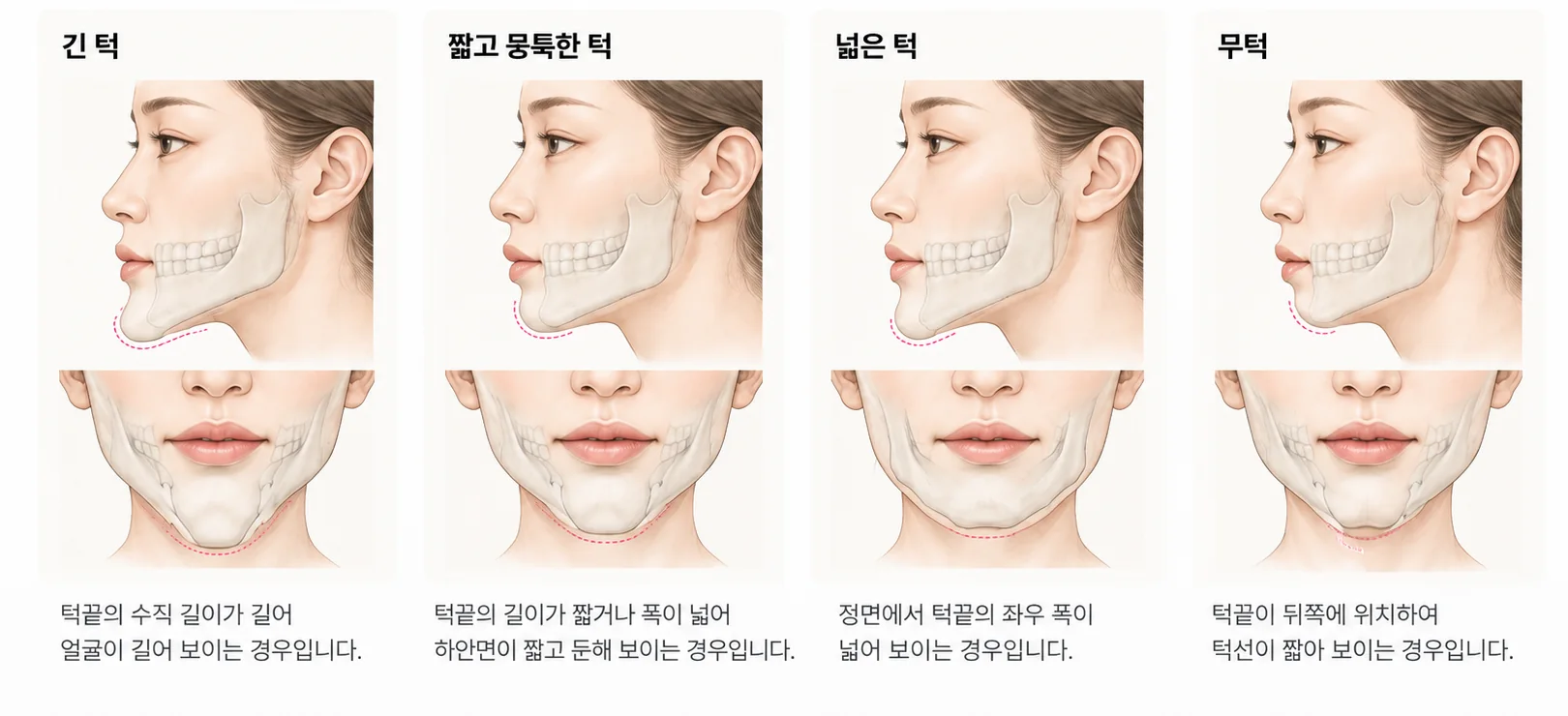
The chin tip affects not only the length and width of the face seen from the front but also the balance of the profile.
Therefore, in planning chin tip surgery, it is important to check the balance of the profile running from the forehead to the nose, lips, and chin tip, along with the width of the mandible and the jawline, rather than looking at the chin tip alone.
Long Chin
This is the case when the vertical length of the chin tip is long and the face looks long. The length of the chin tip and the overall facial proportions are checked, and the length is adjusted by the necessary amount.
Short, Blunt Chin
This is the case when the chin tip is short or wide and the lower face looks short and blunt. The position and width of the chin tip are considered together to plan a more balanced shape.
Wide Jaw
This is the case when the chin tip looks wide from side to side when seen from the front. The width is adjusted in consideration of the width of the chin tip and its connection to the mandibular line.
Receding Chin
This is the case when the chin tip sits toward the back, so the area around the mouth looks relatively protruding from the side or the jawline looks short. When necessary, the chin tip bone segment can be moved forward to adjust the front-to-back balance of the face.
How Is Chin Tip Surgery Performed?
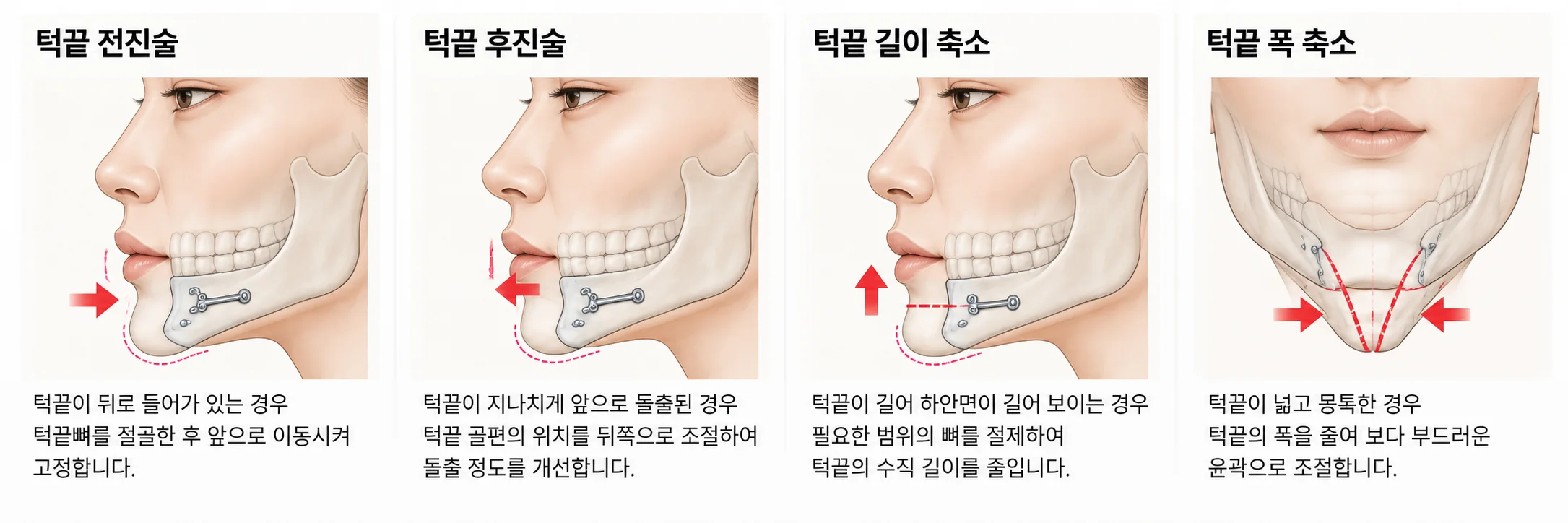
The surgical method differs depending on the shape of the chin tip and the direction that needs to be corrected.
Chin Tip Advancement
When the chin tip is set back, the chin tip bone is cut, and the bone segment is moved forward and fixed. The amount of movement is decided in consideration of the degree of chin tip protrusion and the balance of the profile.
Chin Tip Setback
When the chin tip protrudes too far forward, the position of the chin tip bone segment is adjusted backward to improve the degree of protrusion.
Chin Tip Length Reduction
When the chin tip is long and the lower face looks long, the vertical length of the chin tip is reduced by adjusting the bone within the necessary range.
Chin Tip Width Reduction
When the chin tip looks wide and blunt, its width is adjusted to a softer contour in consideration of the width of the chin tip and its connection to the jawline.
Asymmetry Correction
When the chin tip is shifted to one side, the cause and degree of the asymmetry are checked, and then the position of the chin tip bone segment is adjusted. If asymmetry of the whole mandible is also present, the range that can be corrected may differ.
What Is Considered Together in Chin Tip Surgery?
Vertical Face Proportion
Rather than looking only at the length of the chin tip, the proportions of the upper, middle, and lower face are checked together.
Front-to-Back Position
From the profile, the positional relationship of the nose, lips, and chin tip is checked to determine whether the chin tip needs to be moved forward or backward.
Chin Tip Width
From the front, we check whether the chin tip looks too wide or too narrow, and plan so that it connects naturally with the mandibular line.
Left-Right Asymmetry
We check together whether the center of the chin tip matches the midline of the face and whether asymmetry of the mandible itself is also present.
How Does Surgery That Moves Bone Differ from Implants?
Methods of bringing the chin tip forward include cutting the chin tip bone and moving it, and using an implant.
When the position, length, or asymmetry of the skeletal structure itself must also be adjusted, moving the chin tip bone may be considered, and the appropriate method varies with the degree of correction needed and the condition of the soft tissue.
Rather than deciding uniformly that one method is better, it is important to choose the surgical method after checking the current skeletal structure of the chin tip and the direction of change you want.
What Should I Know After Chin Tip Surgery?
Because chin tip surgery is mostly approached from inside the mouth, visible scars on the outside may be reduced.
Swelling and bruising may occur after surgery, and in the early period the chin tip and the area around the lower lip may feel numb or different. Because the nerves responsible for sensation pass around the chin tip, changes in sensation may occur depending on the surgical scope and your individual condition.
Even after the initial swelling subsides, the bone and surrounding tissue need time to stabilize, so it is better not to judge the final chin tip shape from how it looks right after surgery.
Bleeding, infection, asymmetry, sensation changes, and problems related to bone healing may occur depending on the individual, so the surgical scope and method are decided after checking the bone structure and nerve positions before surgery and holding a thorough consultation.
What Should Be Considered in Chin Tip Surgery?
Chin Tip Surgery FAQ
My long chin makes my face look long. Am I a candidate for chin surgery?
When the vertical length of the chin makes the face look long, chin length reduction can be considered. Along with the chin length, the proportions of the upper, middle, and lower face are checked, and only the needed range is adjusted.
I have a receding chin and my profile bothers me. What options are there?
When the chin sits back and the area around the mouth looks protruded in profile, chin tip advancement, which moves the chin bone segment forward, can be considered if needed. The amount of movement is decided by looking at the relationship among the nose, lips, and chin.
My chin looks wide and blunt. Can its width be reduced?
When the chin looks wide and blunt, there is a method that adjusts it to a softer contour, taking into account the chin width and its connection to the jawline. It is planned so that it connects naturally to the mandibular line from the front.
My chin is shifted to one side. Can it be corrected?
After checking the cause and degree of the asymmetry, the position of the chin bone segment is adjusted. If the whole mandible is asymmetric as well as the chin, the range that can be corrected may differ.
If my chin sticks out too far, can it be moved back?
When the chin protrudes too far forward, chin setback, which moves the chin bone segment backward, can be considered. The direction and amount of movement are decided together with the balance of the profile.
How does using an implant differ from surgery that moves the bone?
Ways to bring the chin forward include cutting and moving the chin bone and using an implant. If the position, length, or asymmetry of the skeleton needs to be adjusted as well, moving the bone can be considered, and which method suits you depends on the skeletal structure and the direction of change you want.
Is the chin enough, or should other contours be reviewed too?
When planning chin surgery, rather than looking at the chin alone, the balance of the profile from the forehead, nose, and lips to the chin, the width of the mandible, and the jawline are checked together. Whether to operate on other areas as well is decided after looking at the overall facial proportions.
What kind of anesthesia is used for chin surgery?
Facial contouring surgery is performed under general anesthesia, and an anesthesiologist is on site during contouring surgery. Details about anesthesia are explained during the pre-surgery consultation.
Do I need to be hospitalized? How long is recovery?
The clinic has inpatient rooms, and contouring surgery involves a 1-day hospital stay. The recovery period is about 2 weeks, and it may vary from person to person.
Where is the incision? Will there be a scar on my face?
Chin surgery is approached from inside the mouth, so in many cases no incision line is made on the facial skin. Scarring and other changes may occur at the incision site inside the mouth, and the degree varies from person to person.
When is swelling worst after chin surgery?
Swelling is generally felt more strongly about 2 to 3 days after surgery than right after it. Swelling and bruising decrease over time, but the degree varies from person to person.
Can the area around my lower lip feel numb after surgery?
Because sensory nerves run around the chin, the chin and the area around the lower lip may feel numb or different at first. In many cases this recovers over time, but depending on the degree of nerve injury, the change in sensation may last a long time.
When can I see the final shape of my chin?
Even after the initial swelling goes down, the bone and surrounding tissue need time to stabilize. It is therefore better not to judge the final chin shape by the appearance right after surgery.
What are the possible side effects of chin surgery?
Depending on the individual, bleeding, infection, asymmetry, changes in sensation, and problems related to bone healing may occur. For this reason, the skeletal structure and the position of the nerves are checked before surgery, and the surgical range and method are decided through a thorough consultation.
What is checked during the consultation?
The vertical proportions of the face, the front-to-back position of the chin, the chin width, and left-right asymmetry are checked together. Before the consultation, you can ask about the area of concern in advance through a KakaoTalk 1:1 consultation.
Chin Tip Surgery — KakaoTalk 1:1 Consultation
You can make a prior inquiry via KakaoTalk before your visit about which area concerns you.
View together by Facial Contouring surgical method
Explore Long-curve square jaw, L-osteotomy zygoma reduction, Chin Tip Surgery, and the full guide to Facial Contouring together.
View cheekbone, square jaw, and chin tip surgeries together on a single page.
FACE Long-curve square jaw reductionThe lower jawline from the jaw angle below the ear toward the chin is resected in a long curve.
FACE L-osteotomy cheekbone reductionThe cheekbone is osteotomized in an L shape and then moved inward.
For additional inquiries, contact us via KakaoTalk
1:1 KakaoTalk pre-inquiry — Mon–Thu 10:00 - 19:00 · Fri 10:00 - 21:00 · Sat 10:00 - 16:00.