

Non-incisional (Buried Suture) Method
What is Non-incisional (Buried Suture) Method Double Eyelid Surgery?
The Non-incisional (Buried Suture) Method is a surgery that does not make a long incision in the skin but instead creates several small points on the eyelid, then uses medical thread to induce adhesion between the skin and the inner eyelid tissue to create a natural double eyelid line.
Compared to the Incisional Method, it causes less tissue damage, and swelling and the recovery period after surgery are relatively less or shorter. It is suitable when eyelid skin sagging is minimal and the tissue is relatively thin. The fixation points and line are designed by considering the individual's eye shape, eyelid thickness, skin elasticity, fat volume, and desired double eyelid height and shape.
At a Glance
Even if you have used double eyelid glue or double eyelid tape, the Non-incisional (Buried Suture) Method can be considered if the eyelid skin is thin and sagging is not severe. On the other hand, if skin sagging is severe or tissue adjustment is needed, the Incisional Method is considered. Bruising and swelling after surgery vary by individual and generally improve gradually over 1-2 weeks.
Non-incisional (Buried Suture) Method Surgery Process
- 1Double Eyelid Line DesignThe length and shape of the eyes, eyelid thickness, and existing wrinkles are checked, and the height and shape of the double eyelid that harmonizes with the face are designed.
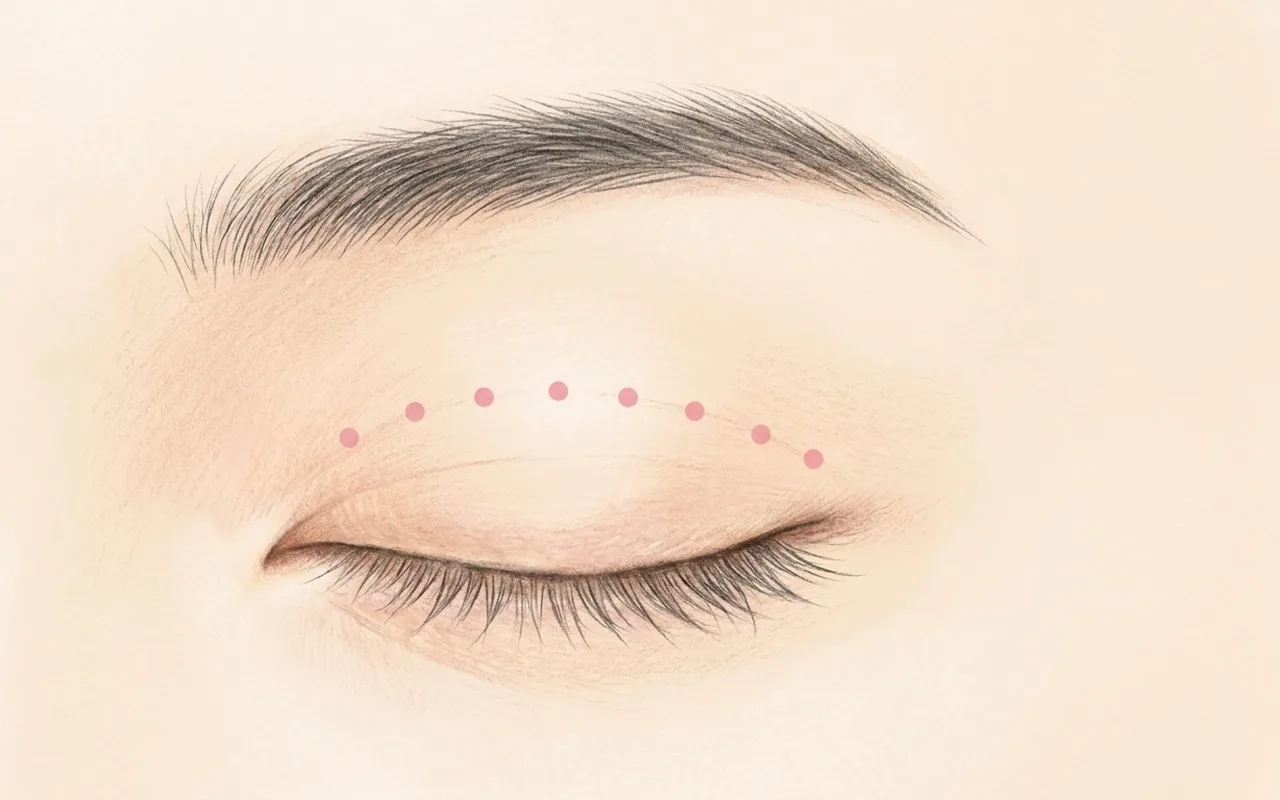
- 2Micro Point FormationSeveral small points are created on the skin along the designed double eyelid line to secure positions for the thread to pass through.
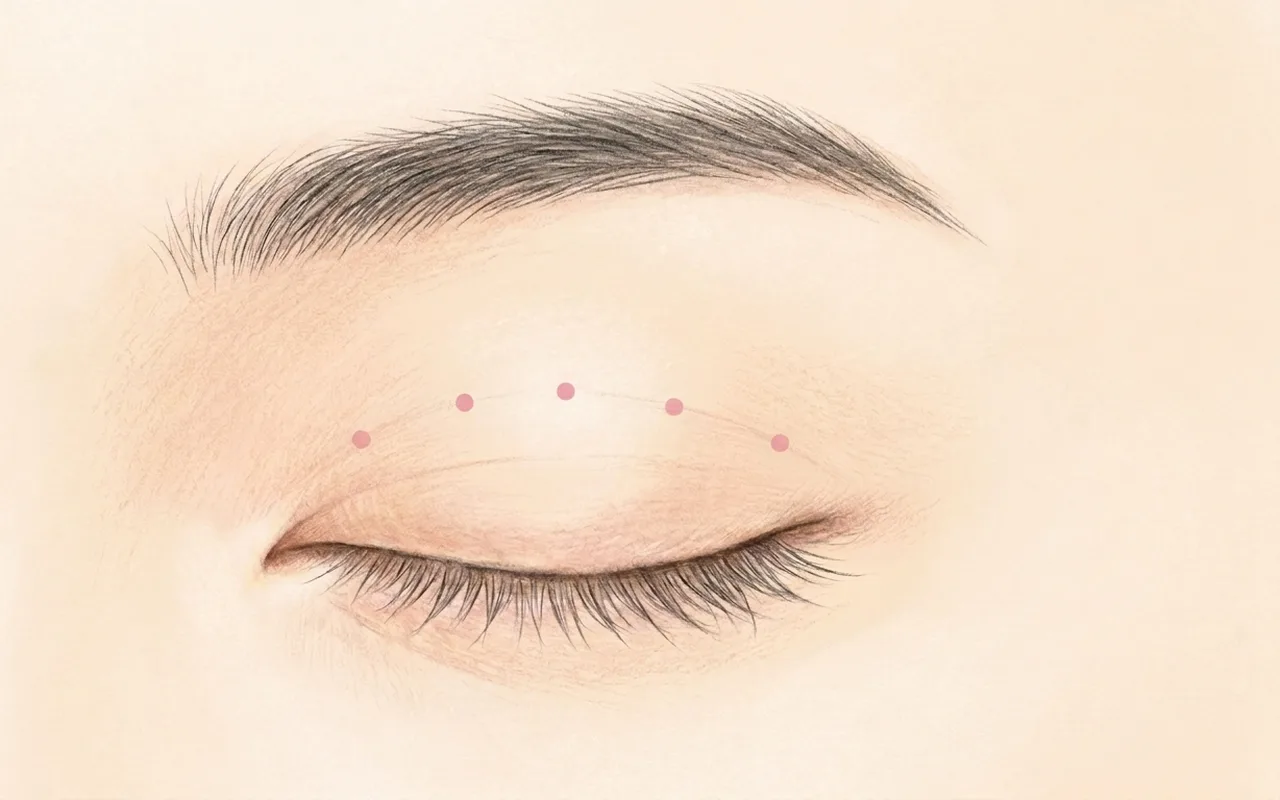
- 3Fixation Using ThreadMedical thread is used to connect the skin and inner eyelid tissue, and it is fixed so that the double eyelid crease forms naturally when the eyes are open.
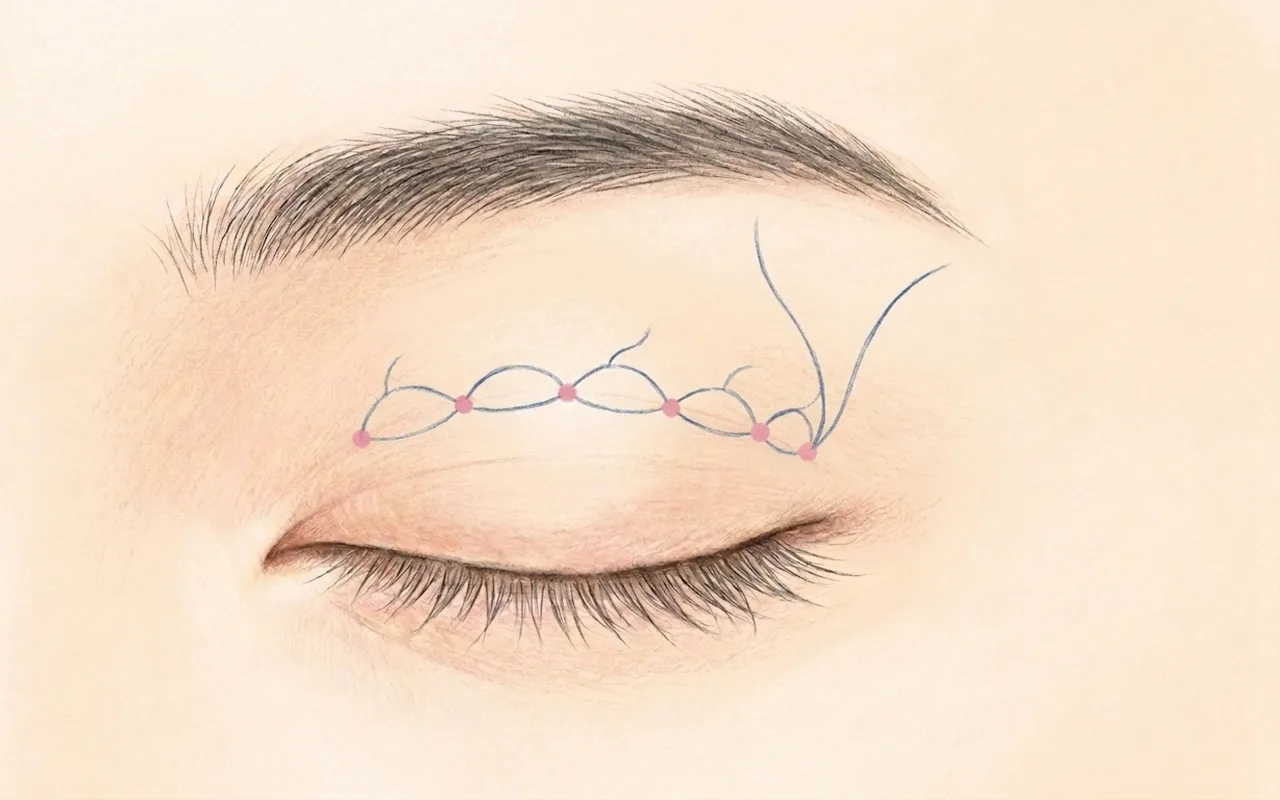
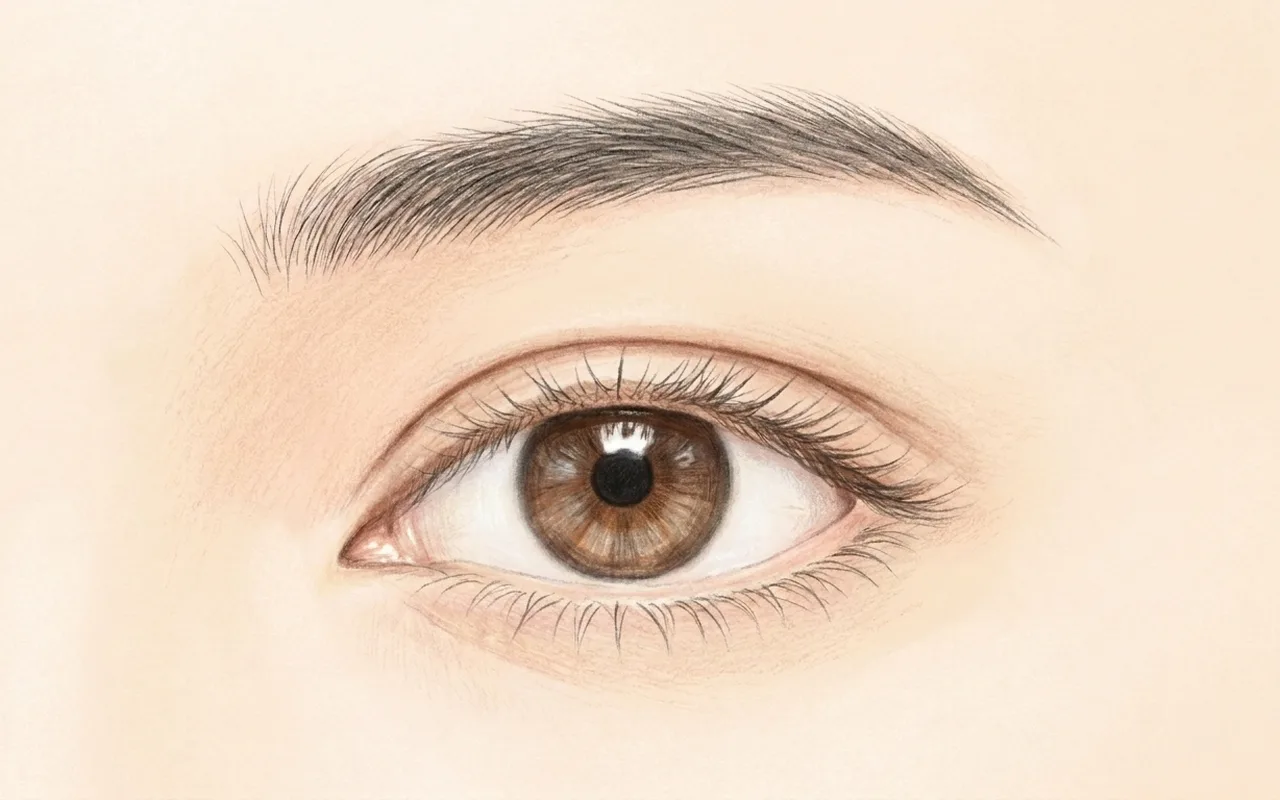
- 4Line and Left-Right Balance CheckThe double eyelid height and depth when the eyes are open, and left-right balance are checked, and it is finished to create a natural line.
Points of the Non-incisional (Buried Suture) Method
What Is the Difference Between the Non-incisional (Buried Suture) Method and the Incisional Method?
The Non-incisional (Buried Suture) Method forms the double eyelid line with thread through small points and is suitable when skin sagging is not severe and the eyelid is relatively thin.
In contrast, the Incisional Method incises the skin along the double eyelid line and can organize the skin, muscle, and fat together as needed, so it can be applied even when the eyelid is thick or there is skin sagging.
Rather than uniformly deciding which method is better, it is important to select the appropriate method according to the anatomical condition of the eyelid and the desired double eyelid shape.
| Category | Non-incisional (Buried Suture) Method | Incisional Method |
|---|---|---|
| Method | Forms the double eyelid line with thread through small points | Incises the skin along the double eyelid line |
| Incision | Does not make a long incision in the skin and uses several small points | Incises the skin along the designed line and then sutures |
| Tissue arrangement and fixation | Connect and fix the skin and inner eyelid tissue with medical thread | Arrange the skin, muscle, and fat together and fix the tissue as needed |
| Suitable eyes | When skin sagging is not severe and the eyelids are relatively thin | Applicable even when eyelids are thick or there is skin sagging |
| Recovery burden | Compared to the incisional method, there is less tissue damage, so the burden of swelling and recovery is relatively low | Initial swelling and recovery period may be longer than with the Non-incisional (Buried Suture) Method, and the timing of suture removal and return to daily life varies by individual |
Non-incisional (Buried Suture) Method, KakaoTalk 1:1 consultation
For the Non-incisional (Buried Suture) Method, anesthesia method and recovery schedule can be inquired in advance via KakaoTalk before consultation.
What is the Non-incisional (Buried Suture) Method?
The Non-incisional (Buried Suture) Method is a method of creating a double eyelid line by knotting the eyelid tissue with thread.
The double buried suture method is a type of Non-incisional (Buried Suture) Method that forms the double eyelid line using multiple fixation points. Swelling, recovery period, and whether the double eyelid line holds may differ depending on eyelid condition and surgical method.
Recommended for
- When desiring a natural double eyelid line
- When the eyelid skin is not sagging much
- When the eyelids are relatively thin and there is not much fat
- When feeling burdened by long incision lines or incisional surgery
- When desiring a relatively quick return to daily life
- When the existing double eyelid line is faint or appears in multiple layers
Recovery and precautions after Non-incisional (Buried Suture) Method surgery
In the early stage after surgery, swelling, bruising, a pulling sensation, or temporary difference in left and right lines may appear, but most become gradually natural during the recovery process.
In the early stage, it is good not to rub the eyes hard or give strong stimulation to the surgical site, and it is good to avoid drinking, smoking, sauna, and strenuous exercise for a certain period. The timing for makeup, face washing, and lens wear follows the medical staff's guidance according to the surgical method and recovery status.
What are the swelling, bruising, and points to note after Non-incisional (Buried Suture) Method surgery?
Swelling and bruising after surgery vary by individual and generally improve gradually over 1-2 weeks.
Immediately after surgery, swelling and bruising can appear differently on both sides, so eye size or eye tail position may look different. The asymmetry of the eyes you originally had also has an effect. Therefore, rather than judging left-right differences based only on the initial appearance, it is better to evaluate after swelling has sufficiently subsided and the tissue has stabilized.
After surgery, wearing contact lenses may irritate the eyelids depending on swelling and tissue recovery. Wearing is generally guided from 3-4 weeks after surgery, but the actual timing may vary depending on recovery.
Frequently Asked Questions about Non-incisional (Buried Suture) Method
Can eyes that have used a lot of double-sided tape, double eyelid tape be done with the non-incisional (buried suture) method?
The surgical method is determined in various ways depending on the desired double eyelid height or the current condition of the eyelids. Even if double-sided tape or double eyelid tape has been used, the non-incisional (buried suture) method can be performed if the skin is on the thin side and not sagging much. If skin elasticity is good, there is a lot of tissue, and there is remaining skin causing sagging, it is thought that surgery with the incisional method would yield better results.
It is day 7 after non-incisional double eyelid surgery and swelling and bruising are severe. Will the bruising be okay?
Although there are some individual differences, bruising in the surgical area and surrounding areas usually almost disappears in about 1-2 weeks. Please observe the progress, and if it gets worse or lasts a long time, visit us to have it checked.
Does the double eyelid Non-incisional (Buried Suture) Method come undone over time?
Since the Non-incisional (Buried Suture) Method has a different fixation method from the incisional method, the line may become shallow or come undone over time. There are differences depending on eyelid thickness, skin sagging, eye-opening strength, lifestyle habits, etc.
Can all desired double eyelid lines be created with the Non-incisional (Buried Suture) Method?
Not only the desired shape but also the current eye structure must be considered together. The eyelid thickness, skin sagging, horizontal and vertical eye length, Mongolian folds, etc. are comprehensively evaluated to determine a line that can be created naturally.
Are the Non-incisional (Buried Suture) Method and Ptosis Correction the same surgery?
They are different. The Non-incisional (Buried Suture) Method is mainly a method of forming a double eyelid line, and Ptosis Correction is a surgery that corrects structures related to the eye-opening function. If necessary, the two surgeries can be performed together.
What side effects can occur after Non-incisional (Buried Suture) Method Double Eyelid Surgery?
Depending on the individual, side effects such as bleeding, infection, swelling, asymmetry, and scarring may occur. Bruising at the surgical site and surrounding area varies by individual, and guidance is typically based on about 1-2 weeks.
What kind of surgery is the Non-incisional (Buried Suture) Method for double eyelids?
It is a surgery that, without a long skin incision, makes several small points in the eyelid and uses medical sutures to induce an adhesion between the skin and the inner eyelid tissue to create a double eyelid line. It suits cases where the eyelid skin is not very loose and there is not much fat.
In what order is the Non-incisional (Buried Suture) Method performed?
After checking eye length and shape, eyelid thickness, and existing folds to design the height and shape of the double eyelid, small points are made in the skin along the line to secure the positions where the suture will pass. Then the skin and inner eyelid tissue are connected and fixed with medical sutures, and the procedure is finished after checking the height, depth, and left-right balance with the eyes open.
For which eyes is the Non-incisional (Buried Suture) Method considered?
It is considered when a natural double eyelid line is desired, the eyelid skin is not very saggy, and the eyelid is relatively thin without much fat. It also applies when you feel hesitant about incisional surgery, want a relatively quick return to daily life, or when the existing double eyelid line is faint or forms multiple folds.
How do the Non-incisional (Buried Suture) Method and the Incisional Method differ?
The Non-incisional (Buried Suture) Method creates the double eyelid line with sutures through small points and suits cases where skin sagging is not severe and the eyelid is relatively thin. The Incisional Method cuts the skin along the line and can trim skin, muscle, and fat together as needed, so it can also be applied when the eyelid is thick or the skin sags. Rather than deciding uniformly which is better, the method is chosen according to the eyelid condition and the desired double eyelid shape.
How demanding is recovery from the Non-incisional (Buried Suture) Method?
Because there is less tissue damage than with the Incisional Method, the burden of early swelling and recovery is generally relatively small. However, how quickly swelling and bruising subside varies from person to person.
Does the Non-incisional (Buried Suture) Method also leave a scar?
How much of a scar remains varies from person to person. The Non-incisional (Buried Suture) Method uses small points rather than incising the whole eyelid, so there is less concern about an incision line.
What should I be careful about after the Non-incisional (Buried Suture) Method?
In the early period, it is best not to rub your eyes hard or put strong stimulation on the surgical area, and to avoid drinking, smoking, saunas, and strenuous exercise for a certain period. Follow the medical team's guidance on when to start makeup, face washing, and wearing lenses, which depends on the surgical method and recovery status.
Can Ptosis Correction or Medial Epicanthoplasty be done together with the Non-incisional (Buried Suture) Method?
Depending on the structure of the eyes and the change you want, surgeries such as Ptosis Correction or Medial Epicanthoplasty can be considered together. Whether to combine them is decided after checking eye-opening strength and the condition of the inner corners of the eyes.
Can I have double eyelid surgery while I have a stye?
If the inflammation has currently subsided and the condition is stable, surgery is often possible, and the decision is made after checking your condition at a consultation. However, if there is pain and the inflammation has not yet fully settled, the stye must be treated first before double eyelid surgery.
Depending on the individual, side effects such as bleeding, infection, swelling, asymmetry, and scarring may occur, and the degree may vary. Please make your decision after sufficient consultation with a specialist.
Double Eyelid Surgery Methods Viewed Together
Please review the Non-incisional (Buried Suture) Method, Incisional Method, Natural Adhesion Method, and the overall guide to double eyelid surgery together.
The Non-incisional (Buried Suture) Method, Incisional Method, and Natural Adhesion Method are viewed together on one page.
EYE Incisional MethodThis is a method of creating a line by making an incision in the eyelid skin.
EYE Natural Adhesion MethodA line is created by adhering tissue with a minimal incision.
For additional inquiries, contact us via KakaoTalk
1:1 KakaoTalk pre-inquiry — Mon–Thu 10:00 - 19:00 · Fri 10:00 - 21:00 · Sat 10:00 - 16:00.